 English
 русский
 Español
 عربى
عربى
JingShi
JingShi
JingShi
JingShi
JingShi
JingShi
JingShi
JingShi
JingShi
Content
- 1 What Is a Warehouse Crane and Why It Matters
- 2 Common Types of Warehouse Cranes
- 3 Crane Type Comparison at a Glance
- 4 Key Factors to Evaluate Before Buying
- 5 OSHA and Safety Requirements for Warehouse Cranes
- 6 Installation Process: What to Expect
- 7 Maintenance Schedule to Maximize Service Life
- 8 Cost Breakdown: What You Are Actually Paying For
- 9 When a Warehouse Crane Pays for Itself
What Is a Warehouse Crane and Why It Matters
A warehouse crane is a fixed or rail-mounted lifting system installed inside a storage or manufacturing facility to move heavy loads horizontally and vertically without relying on forklifts or manual labor. The right crane can cut material-handling time by up to 40% and reduce workplace injuries caused by improper manual lifting.
Unlike mobile equipment, warehouse cranes work within a defined coverage area—usually above the floor—keeping aisles clear and enabling precise load placement. Facilities that handle loads exceeding 1 ton on a regular basis almost always benefit from a permanent crane solution rather than a forklift-dependent workflow.
Common Types of Warehouse Cranes
Choosing the correct crane type depends on coverage area, ceiling height, load weight, and how frequently lifts occur. Below are the most widely used options:
Overhead Bridge Crane
The most common warehouse crane. A bridge travels along two parallel runway rails mounted near the ceiling, and a hoist travels along the bridge beam. This gives full rectangular coverage of the work area beneath. Capacities typically range from ½ ton to 100+ tons. Single-girder models suit lighter, high-cycle applications; double-girder models are preferred for heavy loads and under-hook height requirements.
Jib Crane
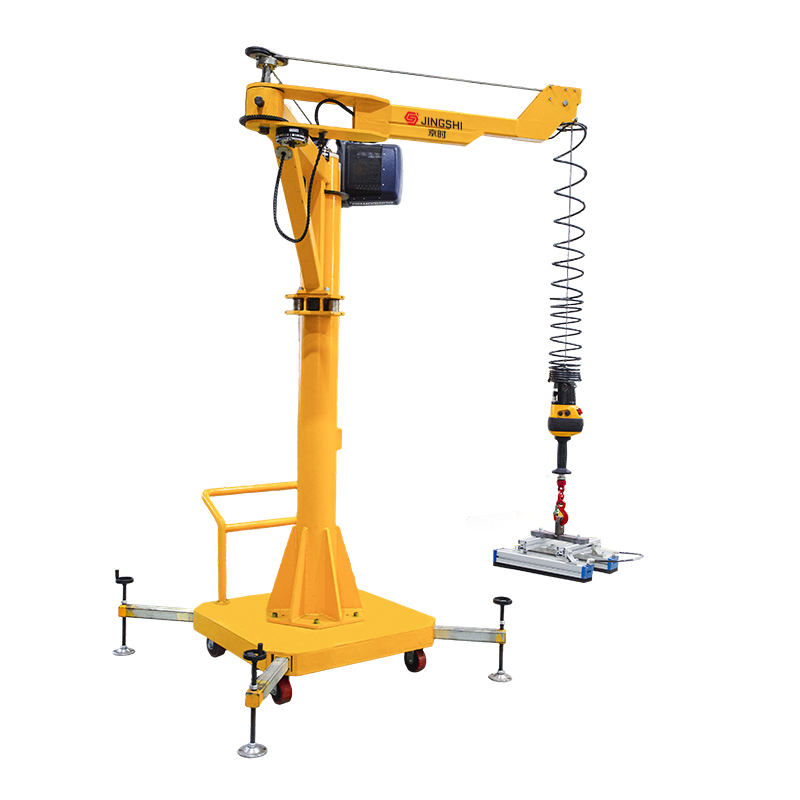
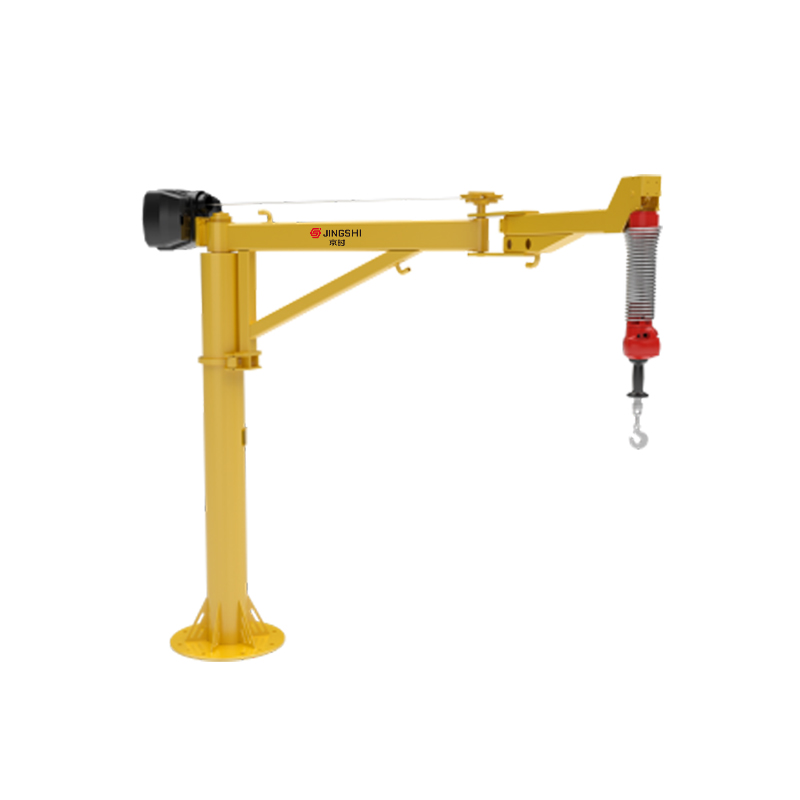
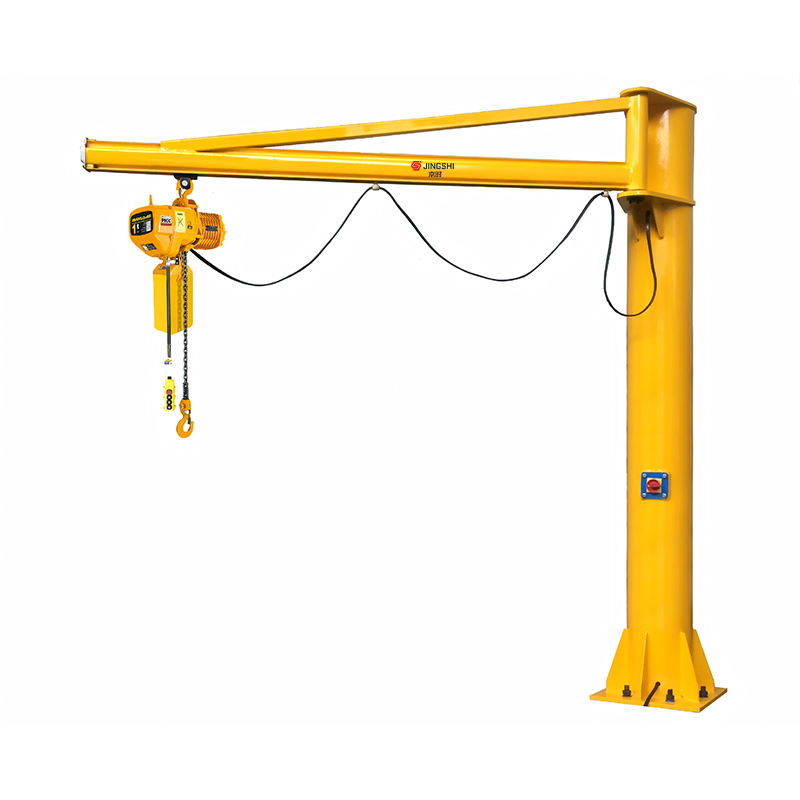
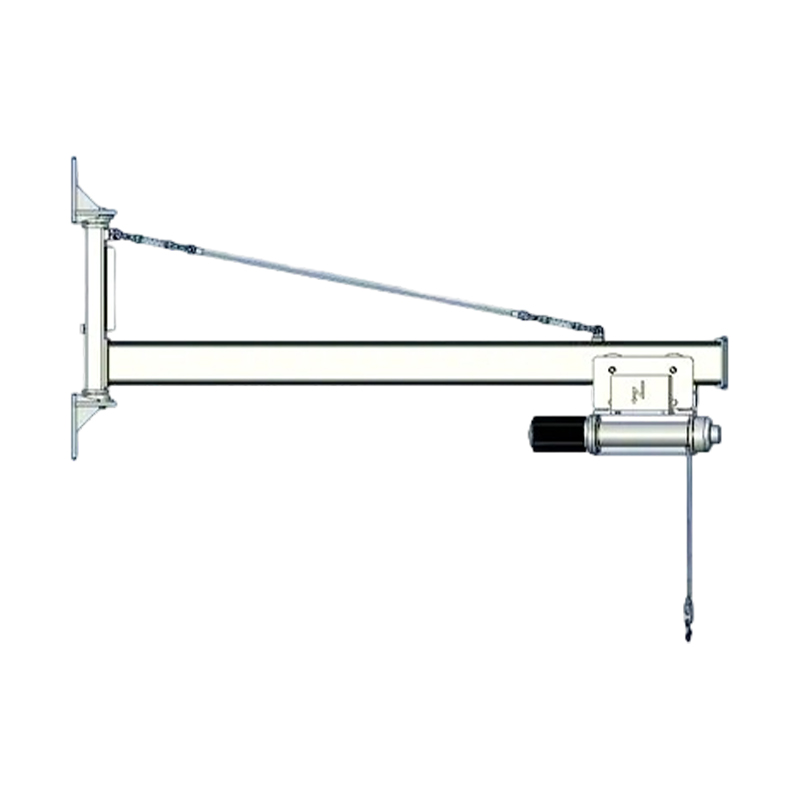
A jib crane consists of a horizontal boom attached to a wall, column, or freestanding mast. The hoist travels along the boom. Coverage is a 180° or 360° arc depending on mounting style. Capacities are typically ¼ ton to 5 tons, making jib cranes ideal for workstation-level service—loading machines, assembly benches, or dock positions—rather than bay-wide coverage.
Gantry Crane
A gantry crane is essentially a bridge crane that stands on its own legs instead of hanging from a building structure. This makes it suitable for facilities with low ceiling strength or outdoor storage yards. Portable gantry cranes on casters can be repositioned easily and are popular for maintenance bays and smaller warehouses. Full-span gantries can handle capacities comparable to overhead bridge cranes.
Monorail Crane
A monorail crane runs a hoist along a single fixed track. It does not provide side-to-side movement unless the track curves or branches. Monorails excel in linear production or assembly lines where loads follow a predictable path—such as moving engine blocks along a manufacturing cell or transferring pallets from a receiving dock to a staging area.
Crane Type Comparison at a Glance
| Type | Typical Capacity | Coverage Pattern | Best Application | Approx. Installed Cost |
|---|---|---|---|---|
| Overhead Bridge | ½ – 100+ tons | Full rectangular bay | Heavy manufacturing, fabrication | $15,000 – $150,000+ |
| Jib | ¼ – 5 tons | 180° or 360° arc | Workstation service | $3,000 – $20,000 |
| Gantry | ½ – 50+ tons | Full span or portable | Low-clearance facilities, yards | $5,000 – $80,000 |
| Monorail | ¼ – 10 tons | Fixed linear path | Assembly lines, production flow | $4,000 – $30,000 |
Key Factors to Evaluate Before Buying
Purchasing a warehouse crane is a long-term structural decision. Getting the specification wrong means expensive retrofits or, worse, an unsafe installation. Evaluate these factors carefully:
Load Capacity and Duty Cycle
Always specify a crane rated above your maximum anticipated load—a common rule is to add 25% headroom. Equally important is duty cycle, defined by CMAA (Crane Manufacturers Association of America) classifications A through F. Class A covers infrequent lifts (standby or maintenance cranes), while Class F covers continuous, severe-duty service such as steel mills or foundries. A warehouse with two to ten lifts per hour typically falls into Class C or D. Undersizing the duty class leads to premature component failure.
Building Structure and Ceiling Height
Overhead bridge cranes transfer significant loads to the building columns or roof trusses. A structural engineer must verify that existing members can support both the crane's dead weight and the rated live load, including dynamic impact factors (typically an additional 15–25% of hoist load). Under-hook height—the usable lift distance—depends directly on ceiling clearance minus the crane runway depth, so facilities with ceilings below 18 ft often choose gantry or jib cranes instead.
Span and Coverage Area
Measure the precise bay width and length the crane must serve. Bridge crane spans beyond 60 feet typically require a double-girder design for deflection control. For irregularly shaped warehouses, a jib crane network or multiple monorail circuits can cover areas that a single bridge crane cannot economically reach.
Control System
Options range from pendant push-button controls (wired or wireless) to radio remote controls and fully automated PLC-based systems. Radio remote controls improve operator positioning and reaction time. Automated warehouse cranes integrated with a warehouse management system (WMS) can reduce cycle times by 30–50% in high-volume distribution centers but require a significantly higher upfront investment.
OSHA and Safety Requirements for Warehouse Cranes
In the United States, warehouse crane operations fall under OSHA 29 CFR 1910.179 (overhead and gantry cranes) for general industry. Non-compliance risks fines starting at $15,625 per violation and can escalate to $156,259 for willful violations. Key requirements include:
- A rated load must be legibly marked on each side of the crane bridge.
- All new or modified cranes must be load-tested to 125% of rated capacity before being placed into service.
- Daily inspections by the operator before each use; monthly inspections by a qualified person; annual inspections documented in writing.
- Limit switches must be tested at the start of each shift to prevent over-travel.
- Operators must be trained and designated as competent for the specific equipment class.
- Minimum headroom clearances between loads and obstructions (typically 3 inches minimum on sides, 18 inches overhead) must be maintained.
Many facilities also adopt ASME B30.2 (overhead and gantry cranes) or B30.11 (monorail cranes) standards voluntarily, as these provide detailed engineering and operational guidance beyond OSHA's minimum requirements.
Installation Process: What to Expect
A typical warehouse bridge crane installation follows these stages:
- Site survey and structural analysis – An engineer evaluates column spacing, floor load, and roof truss capacity (2–4 weeks).
- Permit and engineering drawings – Local building permits are required in most jurisdictions (2–6 weeks depending on municipality).
- Runway steel fabrication and delivery – Lead times for custom runway beams and columns range from 4–12 weeks depending on supplier backlog.
- Installation – Runway erection, bridge assembly, hoist mounting, and electrical connection typically take 2–5 days for a standard 10-ton bridge crane.
- Load testing and commissioning – Required before the crane enters service; includes functional checks of all limit switches, brakes, and controls.
Plan for a total project timeline of 8–20 weeks from initial quote to operational crane, depending on structural complexity and permitting speed.
Maintenance Schedule to Maximize Service Life
A well-maintained warehouse crane has an expected service life of 20–30 years. Neglected cranes develop costly problems—wire rope failures, rail wear, and brake deterioration—that can also create serious safety hazards. Follow this maintenance cadence:
Daily (Operator Checks)
- Test upper and lower limit switches with a no-load run.
- Visually inspect wire rope or chain for kinking, broken wires, or corrosion.
- Check hook latch and load block for deformation.
- Listen for unusual sounds during travel and hoisting motions.
Monthly (Qualified Person)
- Inspect rail joints, end stops, and runway alignment.
- Lubricate bridge and trolley wheels, wire rope, and open gearing.
- Check brake adjustment and measure stopping distances.
- Inspect electrical connections and pendant cable for damage.
Annual (Certified Inspector)
- Full structural inspection of girder, runway beams, and connections.
- Non-destructive testing (NDT) of weld seams on high-duty cranes.
- Wire rope replacement evaluation based on discard criteria (broken wire count per lay length).
- Written inspection report retained for at least 3 years.
Cost Breakdown: What You Are Actually Paying For
The sticker price on a crane hoist unit represents only a fraction of the true project cost. Here is how the total investment typically breaks down for a 5-ton, 40-foot span single-girder bridge crane:
| Cost Component | Estimated Range | % of Total |
|---|---|---|
| Bridge crane (beam + hoist) | $12,000 – $22,000 | 30–40% |
| Runway steel and columns | $8,000 – $18,000 | 20–30% |
| Electrical and controls | $4,000 – $10,000 | 10–15% |
| Installation labor | $5,000 – $12,000 | 15–20% |
| Engineering and permits | $2,000 – $6,000 | 5–10% |
| Total | $31,000 – $68,000 | 100% |
Structural reinforcement—if existing columns cannot support the crane—can add $10,000 to $40,000 to the project and is one of the most frequently underestimated costs at the planning stage.
When a Warehouse Crane Pays for Itself
The ROI calculation for a warehouse crane usually focuses on three categories of savings:
- Labor reduction – Replacing two forklift operators on a shift with one crane operator can save $50,000–$80,000 per year in labor and benefit costs at U.S. wage rates.
- Reduced product damage – Crane lifts are more controlled than forklift maneuvers in tight aisles. Facilities report damage rates dropping by 20–60% after crane installation, depending on product fragility.
- Injury cost avoidance – The average cost of a lost-time workplace injury in the U.S. exceeds $40,000 when direct and indirect costs are combined (Liberty Mutual Workplace Safety Index). Cranes eliminate repetitive heavy-lift injuries entirely for the tasks they cover.
A mid-sized warehouse investing $50,000 in a bridge crane and realizing $35,000 annually in combined labor, damage, and injury savings achieves a payback period under 18 months—a compelling case for most operations moving more than 10 heavy loads per shift.