
 English
 русский
 Español
 عربى
عربى
JingShi
JingShi
JingShi
JingShi
JingShi
JingShi
JingShi
JingShi
JingShi
Folding Arm Crane Manufacturers
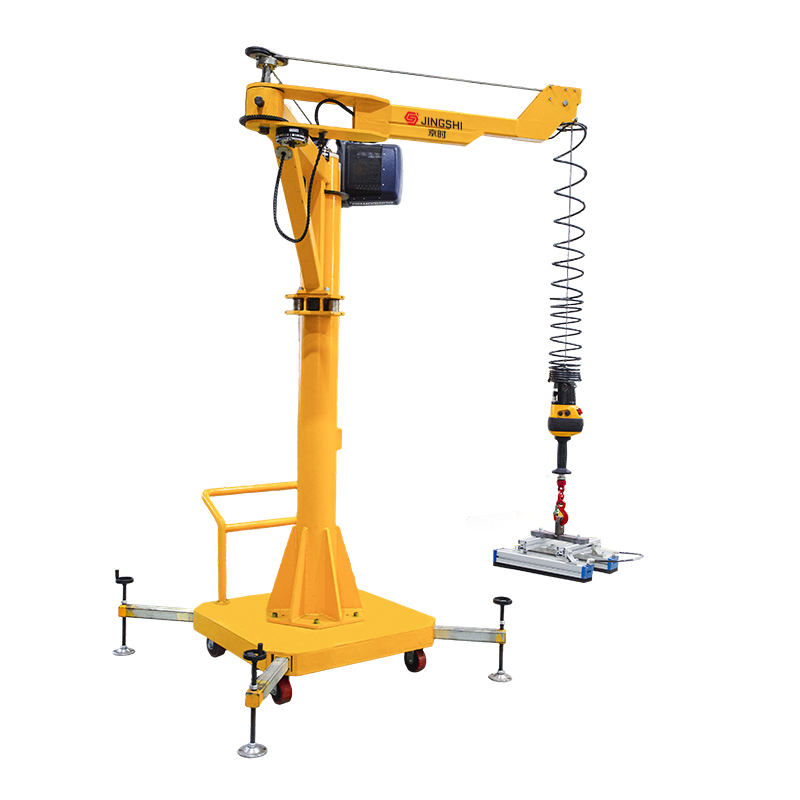

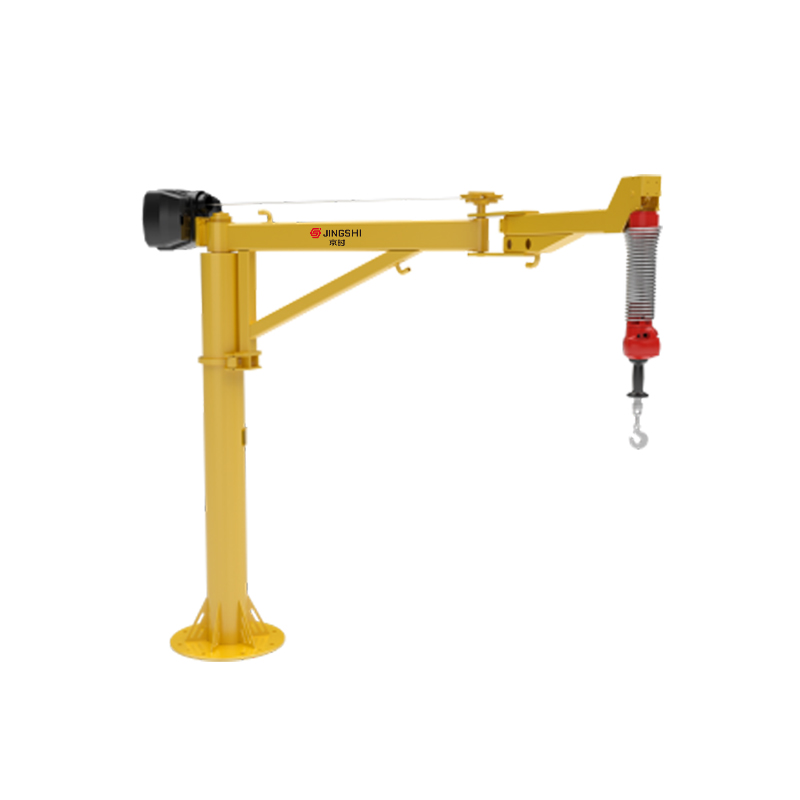
The folding arm crane is based on intelligent control and driven by a servo motor system. Utilizing a levitation function, it balances the weight of the suspended object, allowing the operator to freely lift or lower the load without resistance. It easily completes material handling and hoisting operations. Suitable for fast-paced situations, it features a large vertical lifting stroke and is available in both electric and pneumatic versions. Equipped with power/gas failure protection devices, it is safe, reliable, and flexible in operation.
About Us
Suzhou JingShi Intelligent Equipment Co., Ltd.
Founded in 2016 and headquartered in Suzhou, China, Suzhou JingShi Intelligent Equipment Co., Ltd. is an integrated high-tech enterprise combining research, manufacturing, and trade. We specialize in hydraulic precision leveling machines and intelligent production line systems, Folding Arm Crane Custom, committed to delivering high-precision, high-efficiency, and high-stability sheet-metal finishing solutions to global manufacturers.
As Folding Arm Crane Manufacturers and Folding Arm Crane Suppliers in China, our equipment is widely used in automotive parts, precision sheet metal, elevator components, agricultural machinery, saw blades, precision stamping, profile manufacturing, and electrical applications. Through continuous innovation and technical excellence, JingShi has become a trusted partner for manufacturers around the world.
As Folding Arm Crane Manufacturers and Folding Arm Crane Suppliers in China, our equipment is widely used in automotive parts, precision sheet metal, elevator components, agricultural machinery, saw blades, precision stamping, profile manufacturing, and electrical applications. Through continuous innovation and technical excellence, JingShi has become a trusted partner for manufacturers around the world.
Message Feedback
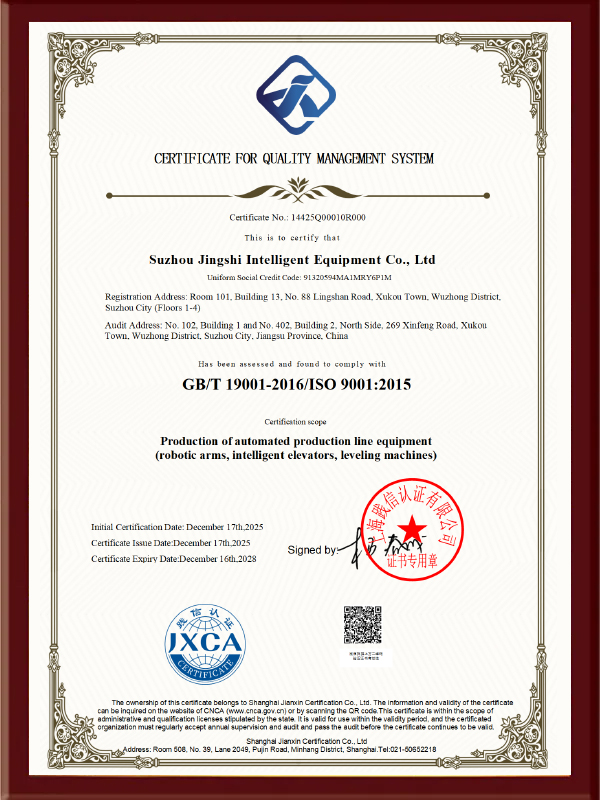
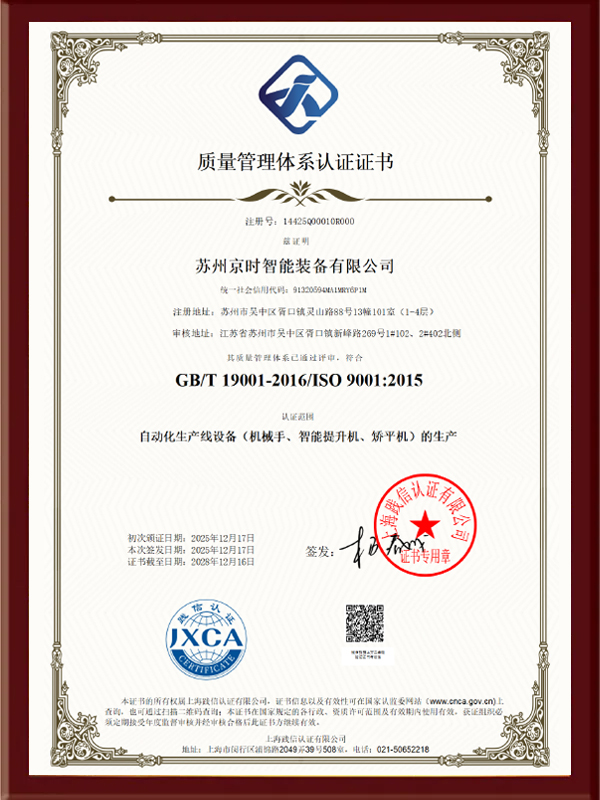
Certificate Of Honor
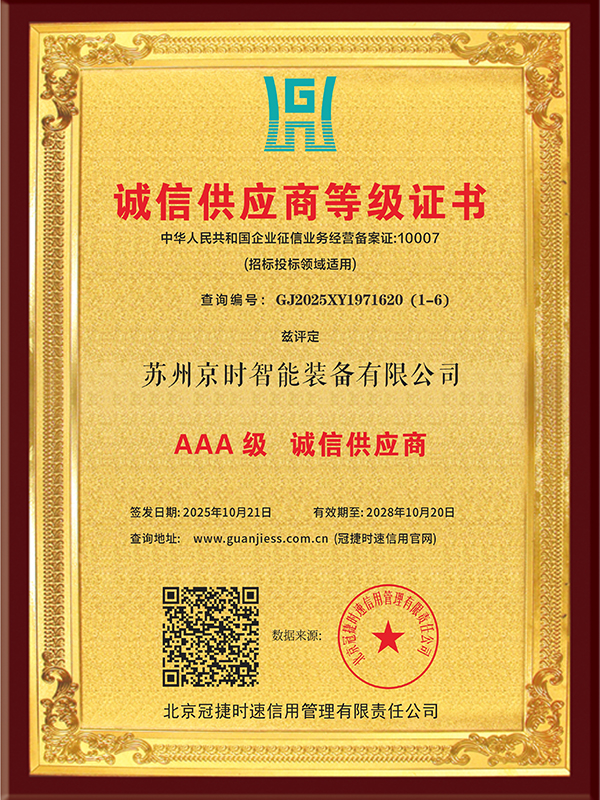
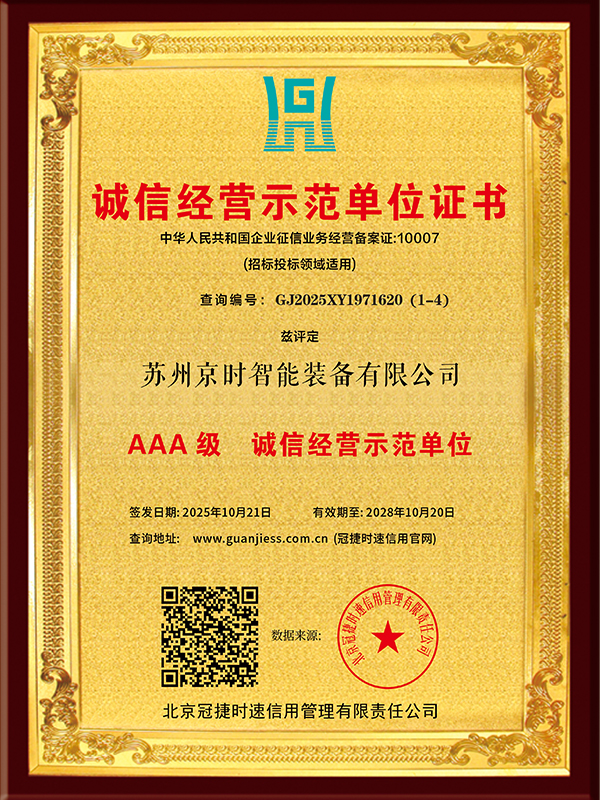
Stay Connected, Insights & Innovation from JingShi
-

 Industry News
 2026.02.23
Crane components determine lifting safety, uptime, and load control. If you understand the key parts—especially the hoist, wire rope/chain, hooks, brakes, boom/jib structure, slewi...
2026.02.23
Crane components determine lifting safety, uptime, and load control. If you understand the key parts—especially the hoist, wire rope/chain, hooks, brakes, boom/jib structure, slewi... -
Industry News
2026.02.16
What Is a Jib Crane? A jib crane is a lifting device with a horizontal rotating arm (the jib) that moves loads within a defined circular or semi-circular area. It’s designed for s...
-
Industry News
2026.02.09
A leveler, also known as a leveling machine or roller leveler, is an industrial machine designed to flatten metal coils, sheets, and plates by eliminating internal stresses, warpi...
-
Industry News
2026.02.02
Pascal's Law: The Foundation of Hydraulic Systems Hydraulic machines work under the principle of Pascal's Law, which states that pressure applied to a confined incompressible flui...
Industry knowledge
Specifying Real Load Conditions: Moment, Reach, and Center-of-Gravity Shift
For folding arm cranes, “rated kg” alone is an incomplete specification. The dominant limiter is typically the load moment at maximum reach, driven by the center-of-gravity (CG) offset of the workpiece plus tooling, and the transient torque created when an operator accelerates, stops, or docks the load.
RFQ data that prevents under-sizing
- Maximum horizontal reach and the full reach envelope (not only “arm length”)
- Worst-case CG offset from the lifting point (include grippers, hooks, vacuum frames, and any adapters)
- Required rotation/flip behavior and the maximum “stop-and-hold” precision at docking
- Duty profile (cycles per hour, shift length, peak vs average utilization)
A practical buying rule is to request a capacity margin on worst-case moment, not just payload, so handling performance remains stable as joints, brakes, and utility conditions evolve in daily production.
Electric vs Pneumatic Versions: What Changes for Precision, Utilities, and Lifecycle Cost
Folding arm cranes are commonly offered in both electric and pneumatic configurations. Beyond headline cost, the choice influences positioning “feel,” repeatability at micro-adjustment, maintenance behavior, and how predictable the system remains under fluctuating plant utilities.
| Dimension | Electric (Servo-Driven) | Pneumatic |
|---|---|---|
| Docking precision and micro-motion | High controllability for fine placement and repeatable stops | Good for general handling; precision depends strongly on air stability |
| Utility sensitivity | Sensitive to power quality and cable routing/IP protection | Air quality/pressure and filtration are decisive |
| Maintenance profile | Drive/control components; planned inspection for connectors and feedback devices | Seals, FRL units, valves; ongoing attention to condensation and contamination |
| Best-fit production context | High-mix lines needing frequent angle fine-tuning and repeatable docking | Cost-sensitive deployment, harsh shop floors, straightforward pick-and-place |
When we support multi-line rollouts, we typically recommend standardizing one architecture per application family so operators retain a consistent handling “feel,” training time drops, and spares planning becomes simpler.
Levitation and “Float” Behavior: Tuning the Balance Window for Mixed Workpieces
Levitation-style assistance enables low-effort lifting and lowering, but bulk buyers should pay attention to the balance window (how wide a weight variation can be handled without re-adjustment) and the transition between fast travel and placement.
Practical questions that influence daily uptime
- How quickly can operators switch between “float” and a more stable placement mode?
- What is the acceptable drift at full reach when the handle is released?
- How does the system behave with partial loads (fixtures only, empty return, or nested parts)?
- Is there a defined method for re-balancing when tooling is changed?
For fast-paced stations, the strongest productivity gains come from predictable transitions—rapid approach, then controlled stabilization—so docking does not become the bottleneck.
Vertical Stroke Planning: Avoiding Hidden Constraints from Headroom, Doors, and Fixtures
A large vertical lifting stroke is valuable, but only if the full stroke is usable in the real workstation. Headroom, guarding, press doors, and conveyor elevations frequently reduce practical stroke and force awkward operator posture.
Integration checks that prevent rework during commissioning
- Confirm the highest and lowest pick points, including pallets, stillages, and stacking tolerances
- Map the motion envelope against doors/guarding to ensure full access without collision
- Reserve clearance for end-effector height, swivels, and quick-change couplings
- Define keep-out zones early to protect sensors, tooling, and operator space
If you share the full envelope constraints up front, we can pre-validate reach and stroke against your layout so the installation lands closer to “bolt-down-and-run” than “modify-and-retest.”
End-Effector and Suspension Interfaces: Designing for Zero-Damage Handling
Bulk handling performance is frequently limited by the interface, not the crane. Especially for sheet metal and cosmetic surfaces, the end-effector strategy determines whether parts arrive aligned, unmarred, and seated consistently.
Interface choices that reduce scrap and rework
- Vacuum: specify cup material for oil film, coatings, and surface temperature; add a reservoir if brief leakage must not drop the part
- Mechanical clamps: match jaw liner material to finish; include poka-yoke geometry to prevent mis-grip during fast takt time
- Magnetic (ferromagnetic only): plan demagnetization if downstream measurement or assembly is sensitive
- Hooks/fixtures: insist on consistent lifting points and anti-mis-hook features for high-repeatability
For volume buyers, modular tool plates with repeatable locating features are a straightforward way to standardize spares, accelerate changeovers, and avoid “trial-and-error” alignment.
Mobile vs Fixed Bases: Matching Deployment to Aisles, Forklift Paths, and Line Rebalancing
Choosing between mobile and fixed folding arm cranes is as much a logistics decision as a lifting decision. The correct choice depends on aisle width, service access, process stability, and how frequently your line is rebalanced.
| Consideration | Mobile Folding Arm Crane | Fixed Folding Arm Crane |
|---|---|---|
| Layout flexibility | High for shared workstations and seasonal re-layouts | Best for stable cells with defined pick/place points |
| Stability at extended reach | Requires disciplined floor conditions and base management | Highest stability for precision docking |
| Aisles and traffic | Must account for forklift routes and parking positions | Easier to guard and define keep-out zones |
| Commissioning effort | Faster redeploy, more checks per move | Lower variation after initial set-up |
For multi-site sourcing, we often see the best results when the same base philosophy is used for the same process family, so safety guarding and operator habits remain consistent across plants.
Power/Gas Failure Protection: What “Safe” Should Mean in an RFQ
For equipment equipped with power/gas failure protection devices, buyers should define the expected behavior during utility interruptions. The goal is not only compliance; it is predictable load retention and motion control under abnormal conditions.
Define response behavior, not only the component list
- On power loss: does the system hold position, brake to stop, or allow controlled descent?
- On air loss (pneumatic): is there a mechanism to prevent sudden drop and unintended swing?
- Overload condition: alarm and lockout vs degraded balancing behavior (define acceptable outcomes)
- Emergency stop: braking should be repeatable and should not cause rebound at extended reach
If you are buying in volume, a standardized risk review template across workstations prevents “spec drift” and keeps safety outcomes consistent from line to line.
Maintenance Planning by Failure Mode: What to Inspect Before Performance “Feels Off”
Assisted lifting systems typically show early degradation as drift, inconsistent stabilization, or increased effort during fine positioning. Preventive maintenance should be planned around the failure modes that matter most to production: holding stability, repeatable stops, and smooth operator control.
High-value checks that protect uptime
- Verify joint play at full reach and confirm there is no progressive sag under steady load
- Check braking reminding/holding performance under repeated stop-and-hold cycles
- Inspect cables/hoses for abrasion points across the full motion envelope
- For pneumatic systems, audit filtration/regulators and drain management to avoid moisture-driven valve issues
- Validate end-effector fasteners and locating features to prevent “hidden” misalignment at docking
In our service practice, the most cost-effective programs focus on early detection of drift and play, because these small symptoms tend to become large quality and safety problems under fast takt time.
Procurement Inputs That Reduce Change Orders: A “One-Page” Technical Annex
Change orders often stem from missing environment and interface details rather than from lifting capacity. A concise technical annex improves quotation accuracy and helps multiple bidders price the same scope.
| RFQ Item | What to Specify | Acceptance Outcome |
|---|---|---|
| Load definition | Max weight, CG offset, fixture mass, lift points | No drift or instability at worst-case reach |
| Motion envelope | Reach map, vertical stroke, keep-out zones | All pick/place points reachable without collision |
| Interface | End-effector type, quick-change needs, utilities at tool | Repeatable docking; minimal cosmetic defects |
| Utilities | Power/air availability, quality expectations, routing limits | Stable behavior across full shifts |
| Abnormal events | Power/air loss behavior, overload response, E-stop behavior | Predictable stop/hold; load retention expectations met |
If you want to source across regions, we can consolidate these inputs into a single annex so purchasing can compare offers on identical technical ground while keeping engineering intent intact.
Contact us
-

-

+ 86 - 4008006155 / + 86 - 512-66064950
-

+ 86 - 16761730338
-

+ 86 - 512-66510623
-

88 Lingshan Road, Xukou Town, Wuzhong District, Suzhou City, Jiangsu Province, China

Copyright © 2025 by Suzhou JingShi Intelligent Equipment Co., Ltd. Rights Reserved. Folding Arm Crane Factory
