 English
 русский
 Español
 عربى
JingShi
JingShi
JingShi
JingShi
JingShi
JingShi
JingShi
JingShi
JingShi
Content
When a coil leaves the leveler looking flat on top but curves away from the straightedge, the problem is rarely a mystery for long. In strip processing, two defects account for many of these frustrating rejects: camber and crossbow. They can look similar to an operator under pressure, but they come from different stress patterns and need different corrections. This article walks through what each defect is, what causes it, and how to correct it without chasing the symptom around the line.
Camber and crossbow: two different directions of trouble
Camber is a side-to-side bend in the plane of the strip. Lay a length of strip on the floor and one edge will appear longer than the other, so the strip curves left or right like a shallow sword. Crossbow is a transverse bow. Look at the cross-section and the center sits higher or lower than the edges, so the strip curls across its width. One defect shows up in plan view; the other shows up when you sight along the cut edge or lay a straightedge across the strip.
Both are residual stress problems, but they are not interchangeable. A leveler setting that removes crossbow can make camber worse, and a heavy-handed attempt to pull out camber can leave the strip bowed across its width. The first step is always to name the defect correctly.
| Feature | Camber | Crossbow |
|---|---|---|
| Appearance in plan view | Strip curves sideways; one edge is effectively longer. | Strip looks straight along its length but is curved across the width. |
| Appearance on a flat surface | Strip rocks from side to side or shows a gap along one edge. | Strip rocks across its width; center or edges lift when pressed flat. |
| Typical source | Edge length difference, thickness wedge, one-sided roll gap, poor side-guide alignment. | Roll deflection, uneven gap across the strip width, incoming coil crossbow, insufficient backup support. |
| First shop-floor check | Compare both edges and check whether side guides are pinching the strip. | Use a straightedge across the width and check the leveler gap at both edges. |
Where camber comes from in leveled strip
Camber usually begins with a difference in length between the two edges. That difference may come from the rolling mill, from a coil that was wound with uneven tension, or from slitting and trimming that released stored stresses. By the time the strip reaches the leveler, the material already wants to curve. The leveler can either help it relax or make the curve worse.
On the machine side, camber appears when the roll gap is not equal from left to right, when a work roll is worn or out of straightness, or when bearing play lets one side of the roll train sit differently from the other. Side guides that are set too tight can also force the strip into a curve, especially on thin material where the guide pressure is enough to plastically deform the edge. A misaligned recoiler or a downstream pull that is not centered can add the same symptom after the leveler.
- Incoming edge wave, wedge, or crown that leaves one edge longer than the other.
- Unequal left-to-right roll gap or a roll that is not parallel to its mate.
- Worn roll shoulders, bearing play, or a damaged backup roll that changes the gap under load.
- Side guides, pinch rolls, or edge trimmers that are not centered with the strip line.
- Slitting or trimming that releases residual stress after the strip has already been leveled.
Why crossbow survives the leveler
Crossbow is often a stiffness and support problem. When the leveler bends the strip, the work rolls want to deflect. If backup support is inadequate, the gap becomes different at the center than at the edges. The strip is then bent more in one zone than another, and the result is a transverse bow that can survive even when the longitudinal flatness looks acceptable.
A narrow strip running on wide rolls is another common case. The strip may only contact a small part of the roll face, so the load is concentrated and the roll deflects in a way the setup was never designed for. Incoming coil crossbow, uneven tension across the width, and a leveler that is asked to take too much bend in one pass can all leave the same signature. Crossbow is not just a roll-gap number; it is a question of how evenly the strip is supported across its width.
Diagnose before you adjust
It is tempting to reach for the adjustment screws as soon as a bad sample appears. A more reliable approach is to isolate the defect. Cut a sample, let it relax on a flat surface, and mark the operator side and drive side before it moves. Check the sample with a straightedge and feeler gauge in both directions. Then check the strip in the line before and after the leveler. If the camber or crossbow is already present before leveling, the machine is being asked to correct an incoming condition. If the defect appears only after leveling, the setup or the roll condition is the first place to look.
- Measure the strip before the leveler, after the leveler, and after the recoiler or shear.
- Record the roll gap at both edges, the entry and exit tilt, and the tension setting for that coil.
- Check whether the defect changes with coil width, thickness, or material yield strength.
- Inspect the work rolls, backup rolls, bearings, and side guides for wear or misalignment.
- Compare a slow line speed with a production speed to see whether the defect is load-dependent.
For a broader reference on what flatness really means in sheet and strip, our guide to sheet metal flatness tolerance standards is a useful companion to these checks.
Corrective actions: start with the leveler, then the line
Leveler setup and mechanical checks
For camber, adjust the left-to-right roll gap in small increments and watch the strip after each change. Do not correct a large camber in one move; the strip needs a chance to show the result. Confirm that the work rolls are straight, that bearing play is within specification, and that the backup rolls are making even contact. For crossbow, verify the gap across the strip width, check roll deflection under load, and make sure the strip is centered on the roll face. A leveler with independent gap control and rigid roll support gives the operator a much better chance of correcting one defect without creating the other.
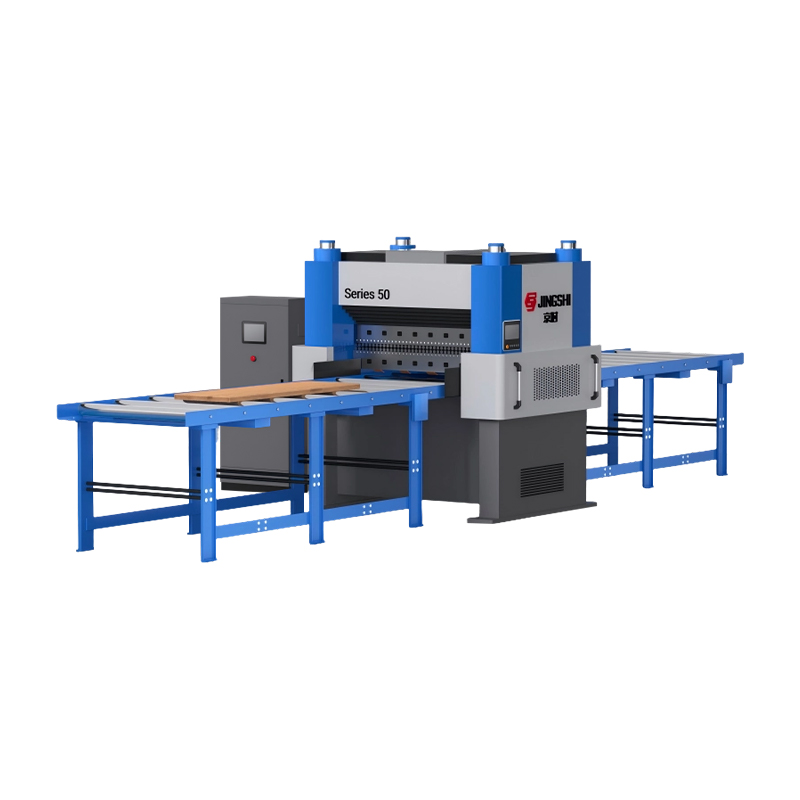 50 Series Four-Column Hydraulic Precision Leveling MachinePrecision leveling machine for 0.8–5.0 mm sheet, using a four-column frame and intelligent hydraulic control to support stable gap and force settings.View Product →
Mechanical condition matters as much as the setpoints. A worn roll or a loose bearing can make a good recipe behave badly on one side of the strip. Keep a maintenance log for roll straightness, bearing clearance, and backup-roll contact, and check the machine after a heavy production run rather than waiting for a reject pile to appear.
Tension, alignment, and downstream equipment
Camber and crossbow can also be introduced after the leveler. The uncoiler, leveler, feeder, and recoiler need to share a centerline. If the recoiler pulls harder on one edge, the strip will curve. If the side guides pinch, the edge will deform. If a CTL line is not tracking squarely, the cut length may look acceptable while the strip still leaves with a bend. Check the line alignment, the tension profile across the width, and the condition of the pinch rolls before blaming the leveler for every defect.
 High-Precision Decoiler Straightener Feeder Cut-to-Length LineIntegrated coil line combining uncoiling, leveling, servo feeding, and shearing; useful when checking line alignment and tension effects on strip camber.View Product →
In a coil line, the leveler is only one part of the stress story. The way the coil is uncoiled, fed, and recoiled can either support the leveling result or undo it. That is why a line-level check is often faster than another round of leveler adjustments.
Prevention that pays back
The best correction is a process that catches the condition early. Inspect incoming coils for edge wave, crossbow, and thickness variation. Record the leveler settings that work for each material and width. Train operators to recognize the difference between camber and crossbow before they touch a screwdown. Keep the roll train clean and within tolerance. These habits do not eliminate every defect, but they turn a frustrating reject into a manageable process variable.
In demanding applications such as automotive and motorcycle parts, where thin strip and visible panels leave little room for error, this discipline is especially valuable. A strip that is flat in one direction but bowed in the other will still cause fit-up problems, coating defects, or unstable feeding. The goal is not just a flat-looking sample; it is a strip that stays flat through the next operation.
Camber and crossbow are different answers to the same question: where is the strip being asked to stretch or bend unevenly? Once you know which defect you are looking at, the correction path becomes much clearer. Check the incoming coil, confirm the roll condition, set the gap with the strip width in mind, and verify the line alignment. The strip usually tells you what it needs, as long as the diagnosis comes before the adjustment.