 English
 русский
 Español
 عربى
عربى
JingShi
JingShi
JingShi
JingShi
JingShi
JingShi
JingShi
JingShi
JingShi
Content
- 1 Bottom line: when a wall-mounted jib crane is the right choice
- 2 Where a wall-mounted jib crane performs best
- 3 Key specifications that define a wall-mounted jib crane
- 4 How to size capacity and reach without overbuying
- 5 Wall and column loading: what must be verified
- 6 Mounting styles and installation overview
- 7 Safety and compliance checklist for daily use
- 8 Cost drivers and a practical ROI example
- 9 Accessories that improve usability
- 10 Wall-mounted jib crane buying checklist
Bottom line: when a wall-mounted jib crane is the right choice
A wall-mounted jib crane is the best option when you need fast, repeatable material handling along a wall or column line—without sacrificing floor space. In most facilities, it’s the most practical way to cover a dedicated work zone (machines, benches, docks) with smooth swing motion while keeping aisles clear.
If your building structure can take the bracket loads and you only need partial rotation (commonly 180°–200°), a wall-mounted jib crane delivers high usability at a lower installed footprint than a freestanding jib.
Where a wall-mounted jib crane performs best
A wall-mounted jib crane is typically selected for “line-of-work” handling—moving loads from a fixed pickup point to one or more nearby set-down points along a wall, row of machines, or structural columns.
Common high-value applications
- CNC and machining cells: lifting vises, fixtures, workpieces into/out of a machine envelope
- Maintenance bays: handling motors, pumps, gearboxes in a defined service area
- Packaging/assembly: feeding parts to a station with minimal walking and rehandling
- Loading zones: repositioning items between pallets, skids, and staging racks
When you should consider another crane type
- You need full 360° rotation (freestanding jibs are often a better fit)
- The wall/column cannot support bracket forces (floor-supported or freestanding designs reduce dependence on the building frame)
- You need long travel along a bay (consider a monorail or bridge crane runway)
Key specifications that define a wall-mounted jib crane
Most wall-mounted jib crane decisions come down to capacity, reach, rotation, headroom, and duty cycle. These determine not only usability, but also the loads your wall brackets transfer into the building structure.
| Spec | Common range (typical offerings) | What it changes |
|---|---|---|
| Rated capacity | 125–2,000 kg (≈275–4,400 lb) | Hoist selection, beam size, bracket forces, safety margin |
| Reach (boom length) | 2–6 m (≈6–20 ft) | Coverage area; longer reach increases bending moment on brackets |
| Rotation | 180°–200° (common) | How much of the work zone is serviceable without repositioning |
| Headroom | Profile depends on hoist/trolley | Whether you can lift close to the underside of structure/ceiling |
| Duty class / usage | Infrequent to continuous cycles | Design life, hoist motor rating, maintenance cadence |
Practical rule: if two cranes have the same capacity, the one with longer reach almost always demands stronger wall/column support because the overturning moment rises linearly with boom length.
How to size capacity and reach without overbuying
Sizing a wall-mounted jib crane is primarily about defining the heaviest handled load and ensuring the boom length covers the set-down locations with safe clearance.
Your rated capacity must cover the lifted item plus below-the-hook devices. A common miss is ignoring grippers, magnets, vacuum lifters, C-hooks, or custom fixtures.
- Example: 450 kg part + 40 kg lifting fixture + 15 kg rigging = 505 kg working load → select a ≥500–630 kg class crane/hoist depending on standards and safety policy
- If loads are frequently near the limit, prioritize a higher capacity class and a more robust duty rating to reduce wear and downtime
Reach: size for workflow, not for “maximum possible”
Longer reach expands coverage, but it also increases the moment on the wall brackets and can make manual slewing feel heavier. Map pickup and set-down points on the floor and size reach to cover them with minimal excess.
- Mark the hook’s needed “service arc” on the floor (pickup, machine mouth, staging table)
- Add clearance for guarding, operator stance, and obstructions (typically 300–600 mm, adjusted to your site)
- Select the shortest boom that still covers the arc—this reduces bracket loads and improves handling
Wall and column loading: what must be verified
The critical risk with any wall-mounted jib crane is not the beam—it is the building interface. The brackets impose vertical loads plus a large overturning moment into the wall/column, and those forces must be verified for the exact steel or reinforced concrete configuration on site.
A concrete example of why reach matters
The turning effect (moment) from a lifted load increases with distance from the wall. For a quick sense of scale:
500 kg is approximately 4.9 kN of force (500 × 9.81 N/kg). At a 4 m reach, the load-only moment is roughly 19.6 kN·m (4.9 kN × 4 m), before adding dynamic effects, trolley/hoist weight, and impact factors.
What your structural check should cover
- Member capacity: wall column/beam section sizes, material grade, and connections
- Bracket spacing and anchor method: bolt grade, embedment, edge distances, and shear/tension interaction
- Deflection limits: excessive flex reduces positioning accuracy and increases wear
- Dynamic factors: starts/stops, side pulls (should be avoided), and any snagging potential
In practice, suppliers often provide bracket reaction loads for your selected wall-mounted jib crane configuration; a qualified structural engineer then confirms the supporting steel/concrete can accept those reactions with appropriate safety factors and code compliance.
Mounting styles and installation overview
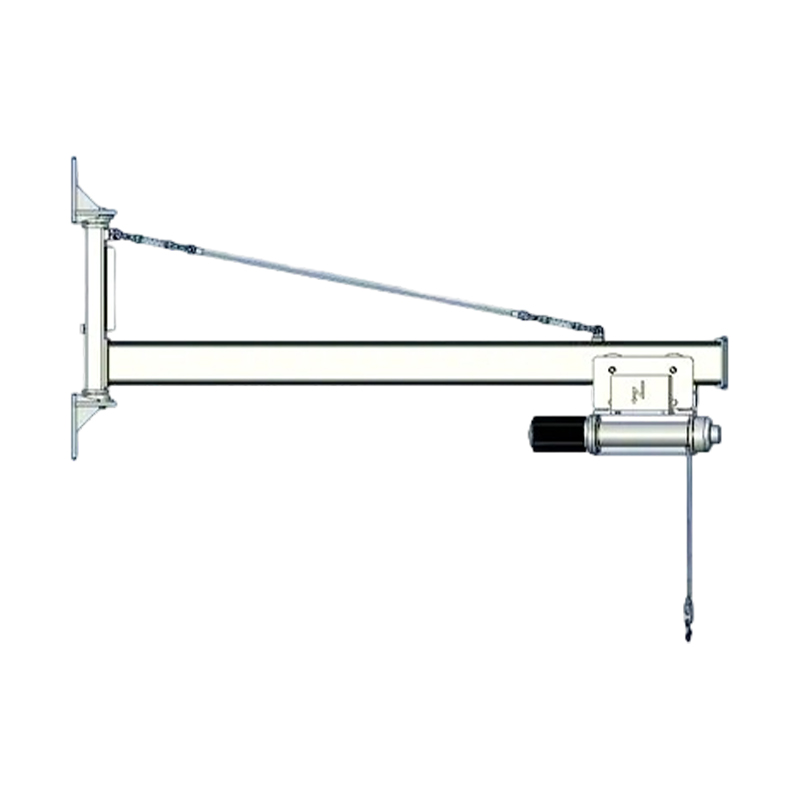
A wall-mounted jib crane is commonly installed using one of two approaches: direct wall/column bracket mounting, or column-mounted bracket systems. The right approach depends on the building frame and the elevation you need for hook coverage.
Typical mounting options
- Wall-bracket mounting: brackets fasten to a structural column or reinforced wall line; best when the structure is designed for crane loads
- Column-mounted bracket systems: brackets clamp/bolt to an existing steel column (when approved by engineering); reduces need for wall reinforcement
- Tie-rod (stabilized) booms: a rod supports the boom to reduce beam size and deflection; requires a strong upper attachment point
Installation steps that prevent rework
- Confirm coverage: boom elevation, clearances, and swing path (including guarding and lighting)
- Verify structure: accept bracket reaction loads and finalize anchor details
- Set brackets plumb and square: misalignment increases trolley drag and accelerates wear
- Install boom and trolley/hoist: confirm end stops and anti-drop features
- Commissioning: functional test, brake test, limit checks, and load test as required by your standards
Operational note: If manual slewing is expected, prioritize smooth bearings and correct bracket alignment; poor alignment is a common reason a wall-mounted jib crane feels “heavy” to swing even at low loads.
Safety and compliance checklist for daily use
Safe performance is driven by three disciplines: correct lifting practices, routine inspection, and control of the work area. A wall-mounted jib crane also requires attention to the bracket interface because loosening or wall movement can progress gradually.
High-impact operating rules
- No side pulling: the crane is designed for vertical lifting; side loads increase swing and anchor stress
- Keep loads low and controlled while traveling; avoid sudden starts/stops
- Maintain a defined swing area; prevent pedestrian traffic under suspended loads
- Use tag lines when needed to prevent spin and collision
Inspection points specific to wall-mounted designs
- Bracket bolts/anchors: look for loosening, cracking, corrosion, or wall spalling
- Boom pivot and bearings: abnormal play, noise, or binding during swing
- Trolley travel: smooth roll, intact end stops, and no wheel flange damage
- Hoist: brake function, load chain/wire rope condition, hook latch, and limit devices
Best practice: document a simple weekly visual check (5 minutes) and a periodic detailed inspection schedule aligned to your duty cycle and applicable regulations.
Cost drivers and a practical ROI example
The purchase price of a wall-mounted jib crane is only part of the installed cost. The most important cost variable is often structural work—reinforcement, engineered anchors, or modifications to columns and connections.
What most strongly affects total cost
- Capacity and reach (beam size and bracket forces increase quickly with reach)
- Hoist type (manual vs electric), lift height, and trolley configuration
- Electrical work (power feed, controls, pendant, festooning)
- Structural engineering and installation complexity (access lifts, shutdown time)
Simple ROI scenario (time recovery)
Assume a work cell performs 30 lifts per day. If a wall-mounted jib crane reduces handling time by 45 seconds per lift (less walking, fewer re-grips), that saves 22.5 minutes/day. Over 250 workdays, that is ~94 hours/year of recovered labor time—often enough to justify the crane even before considering reduced damage, better ergonomics, and higher throughput.
Accessories that improve usability
A wall-mounted jib crane becomes dramatically easier to operate when configured for the real workflow. Small add-ons can reduce operator effort and prevent collisions.
- Powered rotation: helps when frequent slewing is required or loads are near capacity
- Rotation stops: limits swing into aisles, guarding, or fragile equipment
- Anti-collision/end stops: protects the trolley travel limits and nearby fixtures
- Ergonomic pendant height: reduces strain and improves fine positioning
- Below-the-hook tooling: grabs the part correctly to reduce swing and rework
Selection tip: choose accessories that eliminate the most frequent “micro-delays” (repositioning, snagging, swing control). These are usually the largest contributors to real productivity gains.
Wall-mounted jib crane buying checklist
Use this checklist to align engineering, operations, and purchasing before you request quotes. It prevents the most common misfits (insufficient structure, wrong reach, poor headroom).
- Load profile: max handled weight including lifter/rigging, and typical weight distribution
- Reach map: pickup/set-down points, obstructions, required rotation arc
- Headroom: lowest overhead constraint and required hook height at the set-down point
- Duty cycle: lifts per hour/day, average lift height, and speed expectations
- Structure: column/wall type, connection details, and access for anchor installation
- Controls: manual vs electric hoist, pendant vs radio, and power routing
- Safety plan: swing area control, signage, training, and inspection intervals
Decision rule: if the structure check is uncertain, resolve it before finalizing reach and capacity—structural constraints often dictate the most economical wall-mounted jib crane configuration.