 English
 русский
 Español
 عربى
عربى
JingShi
JingShi
JingShi
JingShi
JingShi
JingShi
JingShi
JingShi
JingShi
Content
- 1 What a Mobile Folding Arm Crane Does Best
- 2 How to Size One Correctly: Capacity at Reach, Not Just “Max Tons”
- 3 Typical Configurations and What Their Specs Mean in Practice
- 4 Setup and Stability: The Checklist That Prevents Tip-Overs
- 5 Reading Load Charts Without Guesswork
- 6 Operational Best Practices for Speed and Safety
- 7 Maintenance and Inspection: Focus Where Failures Start
- 8 Procurement Checklist: What to Specify So You Get the Right Crane
A mobile folding arm crane is the right choice when you need flexible lifts without dedicating floor space—provided you size it by working radius (reach) and stabilize the base as carefully as you would any fixed crane. If you match the crane’s rated capacity to your farthest pick point, confirm the hoist is not the limiting factor, and set up on a stable surface with proper outriggers/anchoring, you can move, store, and deploy lifting capability with minimal disruption.
What a Mobile Folding Arm Crane Does Best
A mobile folding arm crane combines two practical advantages: mobility (rolling base, vehicle mount, or repositionable frame) and a folding boom that reduces storage footprint. This makes it suitable for short, repeated lifts—loading machines, positioning components, handling pallets, moving motors/gearboxes, or servicing equipment where a permanent jib or overhead system is not justified.
When it is a strong fit
- You lift in multiple bays or rooms and cannot justify multiple fixed cranes.
- You need occasional lifts and want the arm to fold away between jobs.
- Your loads are awkward and benefit from controlled positioning at the boom tip.
When to choose another solution
- High-frequency production lifting: an overhead system typically yields faster cycles and fewer setup steps.
- Very long reach requirements: capacity drops quickly with radius, so a purpose-built mobile crane or telehandler may be more appropriate.
- Soft or uneven ground: stability control becomes complex and risk increases significantly.
How to Size One Correctly: Capacity at Reach, Not Just “Max Tons”
The single most common sizing error is buying based on the maximum rated load at the shortest radius. For a folding arm crane, what matters operationally is the rated capacity at your farthest working radius (the point you most often pick from or place to).
Use lifting moment to sanity-check sizing
A practical check is lifting moment (torque), typically expressed as tonne-meters (t·m) or kN·m. A simplified estimate is:
Required moment ≈ Load (tonnes) × Radius (m)
Example: If you must lift 800 kg at a 3.0 m radius, that is 0.8 t × 3.0 m = 2.4 t·m before considering dynamic effects, sling angles, or any derating. In procurement terms, you would typically look for a crane whose rated chart comfortably exceeds that requirement at that radius, not merely at minimum extension.
Even if the boom is rated for a higher load, the system limit may be the hoist, winch line pull, hook block, or rigging. If the hoist is rated below the crane’s maximum, the real capacity is the lower number. Always match the hoist rating to the worst-case load at the required radius.
Typical Configurations and What Their Specs Mean in Practice
“Mobile folding arm crane” is used for several practical formats. The best choice depends on where the crane lives (shop floor vs vehicle), how often it moves, and how you achieve stability (wheelbase, outriggers, anchoring, counterweight).
| Configuration | Common capacity range | Common reach/height range | Best use case | Primary sizing risk |
|---|---|---|---|---|
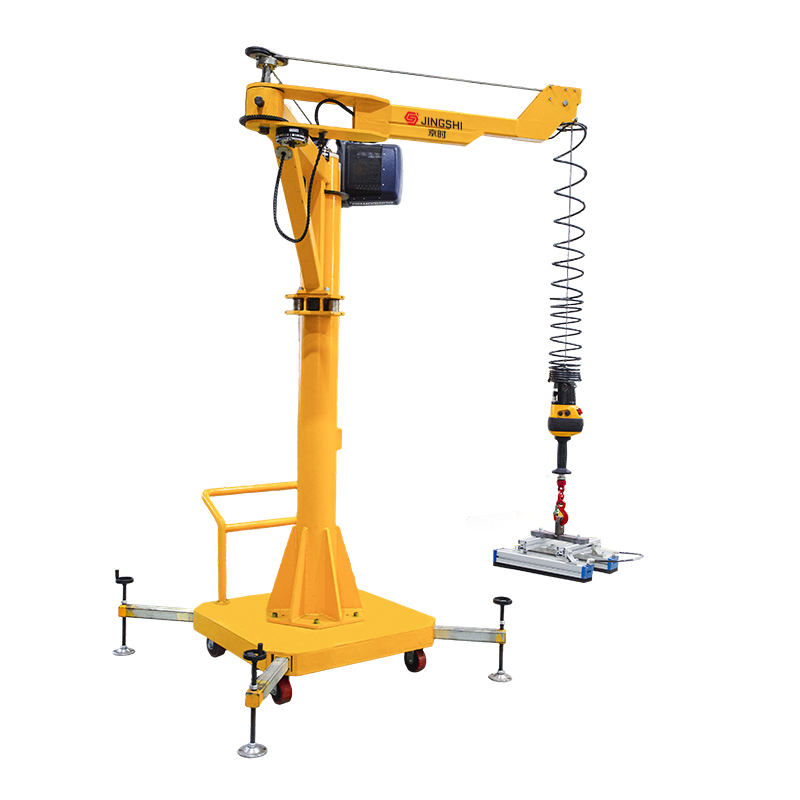
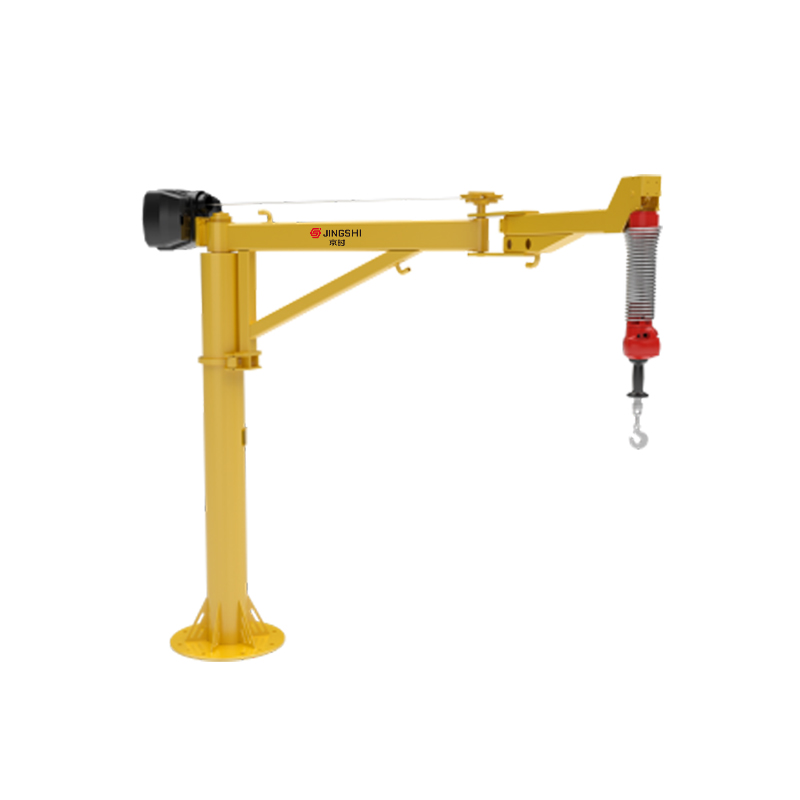
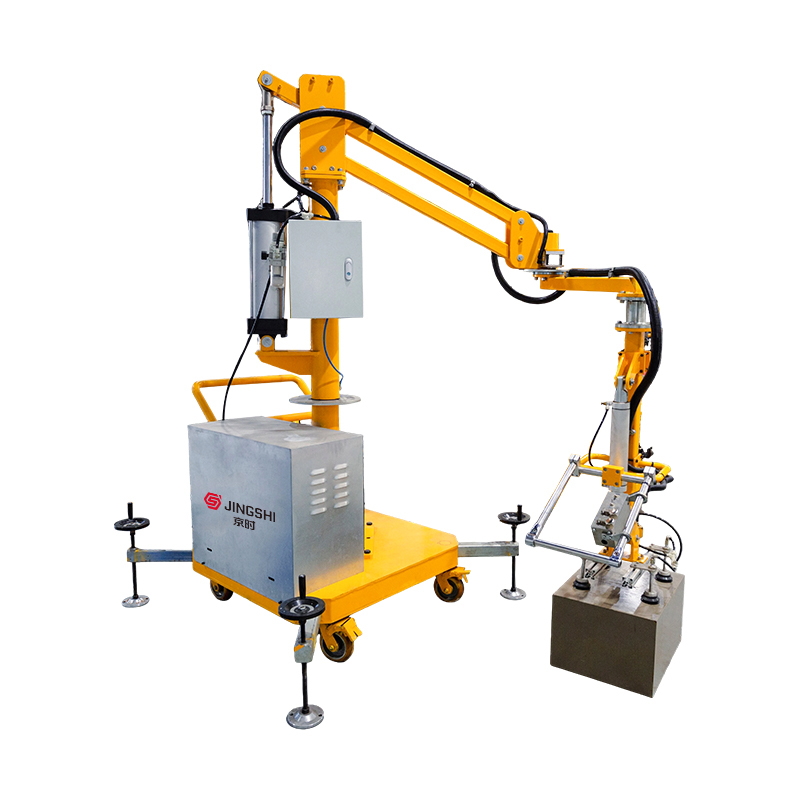
| Portable mobile jib (folding/adjustable arm) | 0.25–1.0 t | Arm up to ~4 m; lift height up to ~4 m | Maintenance bays, light fabrication, machine service | Underestimating tip-over risk when moved with load |
| Foldable gantry (portable frame) | 0.5–1.0 t | Span/height varies by model; compact storage | Indoor moves, frequent setup/teardown, tight storage | Assuming it behaves like an overhead crane on poor floors |
| Truck/pickup-mounted folding arm (knuckle boom class) | ~0.9–2.7 t class and above (model dependent) | Lift height commonly up to ~5.5 m on smaller units; reach varies | Field service, delivery handling, yard work | Ignoring outrigger footprint and ground bearing pressure |
The key takeaway is that “capacity” is not a single number. For a folding arm, you must evaluate the full working envelope: boom angle, extension stage, slew position, and whether outriggers are deployed.
Setup and Stability: The Checklist That Prevents Tip-Overs
Most serious incidents involve stability, not hoist failure. A folding boom can create large overturning moments quickly when extended, slewed, or stopped abruptly. Treat setup as a repeatable procedure—not an informal habit.
Minimum stability checks before every lift
- Surface condition: confirm the floor/ground is level, rigid, and not oil-slicked or broken.
- Outriggers/feet: deploy fully where applicable; use pads on softer ground to reduce bearing pressure.
- Brakes and wheel chocks: lock casters or vehicle brakes; chock wheels if there is any slope risk.
- Clear swing path: verify the boom can slew without contacting racks, machines, or personnel routes.
- Load path: plan a vertical lift first, then a controlled slew—avoid “dragging” loads sideways.
A practical rule for mobility
Do not roll a mobile base with a suspended load unless the manufacturer explicitly rates the crane for that operation. Even small floor joints can create shock loads and rapid moment changes at full reach.
Reading Load Charts Without Guesswork
A load chart answers one question: “What is the maximum allowable load at this exact configuration?” For folding arms, configurations multiply quickly because the boom has multiple sections, joints, and working angles.
What to confirm on the chart
- Rated capacity at your farthest routine radius (not the “headline” maximum).
- Whether ratings assume outriggers deployed, specific outrigger width, or a specific base condition.
- Any derating for side loading, slewing, wind limits, or use of attachments (hooks, winches, grabs).
- The net load after subtracting hook block, lifting beam, grabs, or other below-hook devices if required by the manufacturer.
If the chart is not available, incomplete, or ambiguous for your configuration, treat the lift as non-routine and stop until the correct rating information is obtained.
Operational Best Practices for Speed and Safety
A well-run mobile folding arm crane operation looks consistent: the same checks, the same communication, and controlled motions. This reduces both incident risk and cycle time variability.
A repeatable lift sequence
- Position and stabilize the base (outriggers/pads, brakes, level check).
- Rig the load with known-rated slings and hardware; keep the hook centered over the load.
- Test lift a few centimeters to verify balance, brake holding, and rigging seating.
- Lift vertically to a safe travel height; then slew/position slowly with a spotter if needed.
- Set down, release tension, and only then detach rigging.
Controls and safeguards that materially reduce risk
- Overload protection or load moment limiting for chart compliance.
- Load-holding valves to prevent uncontrolled movement if hydraulic pressure drops.
- A load cell or crane scale for frequent “unknown weight” scenarios.
- Remote controls for tight placements where the operator’s sightline is otherwise compromised.
Maintenance and Inspection: Focus Where Failures Start
Mobile equipment sees vibration, impacts, and frequent repositioning—conditions that accelerate wear at joints and mounting points. Preventive maintenance should emphasize structural connections and hydraulic integrity.
High-value inspection items
- Boom pivot pins and bushings: check for play, lubrication condition, and abnormal wear.
- Mounting base and fasteners: look for deformation, cracks, or loosened bolts after heavy lifts.
- Hydraulic hoses and fittings: inspect for weeping, abrasion, and hose routing pinch points.
- Hook, latch, and block: verify deformation limits and smooth rotation; replace at specified wear thresholds.
- Casters/brakes (mobile bases): ensure they lock reliably and do not drift under load.
Document inspections and repairs. If an incident occurs, traceability (what was checked, when, and by whom) is often as important as the mechanical work itself.
Procurement Checklist: What to Specify So You Get the Right Crane
To avoid paying for capacity you cannot safely use—or buying a crane that cannot reach the work—define requirements in operational terms. A strong request for quote (RFQ) describes the lift, not just the crane class.
Information to include in an RFQ
- Maximum load and typical load, plus the farthest radius where each must be handled.
- Required lift height (hook height) and any obstructions that constrain boom angle.
- Base constraints: doorway widths, floor capacity limits, turning radius, storage footprint.
- Duty cycle: lifts per day, average lift duration, indoor/outdoor exposure.
- Safety expectations: overload protection, load-holding valves, remote controls, or load measurement.
Conclusion: A mobile folding arm crane delivers maximum value when you purchase it for the capacity you need at full working radius, stabilize it consistently, and operate it with chart discipline. Size by reach, confirm the hoist rating, and treat setup as non-negotiable.