 English
 русский
 Español
 عربى
عربى
JingShi
JingShi
JingShi
JingShi
JingShi
JingShi
JingShi
JingShi
JingShi
Content
- 1 Why Standard Industrial Lifters Don't Belong in a Cleanroom
- 2 ISO 14644 Cleanroom Classifications and Equipment Implications
- 3 Material and Construction Requirements for Cleanroom Lifters
- 4 Types of Cleanroom Lifting Solutions
- 5 Vacuum Lifters in Cleanroom Environments: Specific Design Considerations
- 6 Industries That Depend on Cleanroom Lifting Equipment
- 7 Specifying a Cleanroom Lifter: A Practical Checklist
Why Standard Industrial Lifters Don't Belong in a Cleanroom
Bring a standard industrial vacuum lifter or chain hoist into a cleanroom and the problem becomes apparent almost immediately. Conventional equipment sheds particles. Painted steel surfaces flake under repeated cleaning cycles. Lubricated chains and gearboxes weep oil that aerosolizes under movement. Rubber components outgas volatile compounds. Open bearing housings trap contaminants and then release them. In a standard factory, none of this matters. In an ISO-classified cleanroom, any of these failure modes can compromise an entire batch, trigger a regulatory audit, or shut down a sterile production line.
The distinction is not about the lifting function — a cleanroom lifter moves loads the same way any other lifter does. The distinction is about what the equipment does not introduce into the environment while performing that function. Every material, surface finish, fastener, seal, and lubricant on the equipment is a potential particle or contamination source. Cleanroom-rated lifting equipment is engineered to eliminate each of those sources systematically, not as an afterthought but as the primary design constraint.
ISO 14644 Cleanroom Classifications and Equipment Implications
The international standard governing cleanroom air cleanliness is ISO 14644-1, which classifies cleanrooms by the maximum allowable concentration of airborne particles per cubic meter of air. The scale runs from ISO Class 1 — the most stringent, with fewer than 10 particles of 0.1 µm or larger per cubic meter — through ISO Class 9, which approximates normal room air. Each step up the scale represents roughly a tenfold increase in permitted particle concentration.
For equipment selection, the ISO class of the room sets the ceiling for how much particle generation the lifting equipment can contribute. The practical implications differ significantly across the range:
- ISO Class 3–5 (semiconductor wafer fabrication, advanced pharmaceutical sterile filling) — Equipment must be virtually non-shedding. Only highly polished stainless steel with continuously welded, crevice-free seams is acceptable. Lubrication is either eliminated entirely or replaced with cleanroom-grade dry lubricants. Compressed air used in pneumatic systems must be exhausted outside the room, not into it. Cleaning with IPA or other aggressive agents must be possible without surface degradation.
- ISO Class 6–7 (pharmaceutical manufacturing, medical device assembly, precision optics) — Electropolished stainless steel remains the standard material. Sealed bearing units, oil-free drive mechanisms, and smooth, washdown-compatible surfaces are required. Equipment must tolerate regular disinfection without corrosion or surface breakdown.
- ISO Class 8–9 (food processing, general biotech, electronics assembly) — Stainless steel construction is still strongly preferred, but the tolerance for trace particle generation is somewhat wider. Equipment must be easy to clean and must not harbor bacteria in surface crevices, threaded recesses, or hollow tubing.
A lifter specified for an ISO 8 environment is not automatically suitable for ISO 5. Equipment that crosses from a lower-class to a higher-class zone must be fully re-evaluated — and in many regulated facilities, re-validated — before use.
Material and Construction Requirements for Cleanroom Lifters
The material specification of a cleanroom lifter is not a preference — it is a compliance requirement tied directly to the ISO classification of the operating environment. Each element of the equipment must be evaluated not just for mechanical function but for its contamination profile.
- Stainless steel construction — Grade 304 stainless is the baseline for most ISO 7–9 environments. Grade 316 or 316L is specified for ISO 5–6 and for any environment where aggressive cleaning agents, saline solutions, or acids are regularly used. The corrosion resistance of 316 matters less for the steel itself and more for the integrity of the surface finish over years of disinfection cycles.
- Surface finish and weld quality — Cleanroom lifters must have smooth, continuously welded seams with no crevices where particles, fluids, or microorganisms can accumulate. Polished surfaces — typically Ra 0.8 µm or finer for pharmaceutical environments — minimize particle adhesion and are easier to verify as clean after a wipe-down. Sharp edges, raw threads, and exposed hollow sections are incompatible with cleanroom design.
- Lubrication-free or closed-system lubrication — Open lubrication points that require periodic greasing are not acceptable in most cleanroom contexts. Sealed-for-life bearing units, dry-film lubricants, or food-grade lubricants certified for incidental contact are the standard alternatives. Any lubricant used must have documented compatibility with the cleaning agents used in the facility.
- Non-outgassing materials — Control handles, grips, hose covers, and any polymer components must be specified from materials that do not outgas volatile organic compounds under operating temperatures. Silicone components, in particular, must be verified as compatible — standard silicone releases low-molecular-weight fragments that can contaminate sensitive surfaces in semiconductor and optics environments.
- Fasteners and hardware — All fasteners must be stainless steel with internal drive recesses (not open-slotted heads that trap particles), and wherever possible, fastener counts should be minimized in favor of welded construction.
Types of Cleanroom Lifting Solutions
Cleanroom lifting requirements span a wide range of load sizes, frequencies, and facility layouts. No single equipment type covers all scenarios — the right configuration depends on the specific handling task.
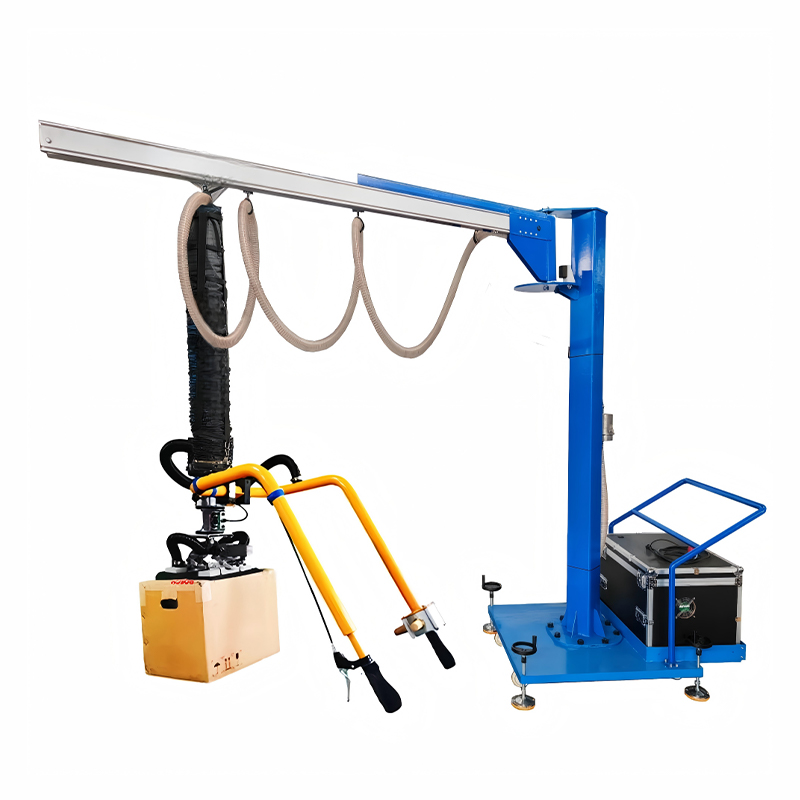
- Cleanroom vacuum lifters — The most versatile option for lifting flat or moderately curved materials including glass panels, metal plates, trays, and packaged components. Available in both fixed and mobile configurations. See the full vacuum lifter range for industrial and controlled environments for configuration options across different load capacities.
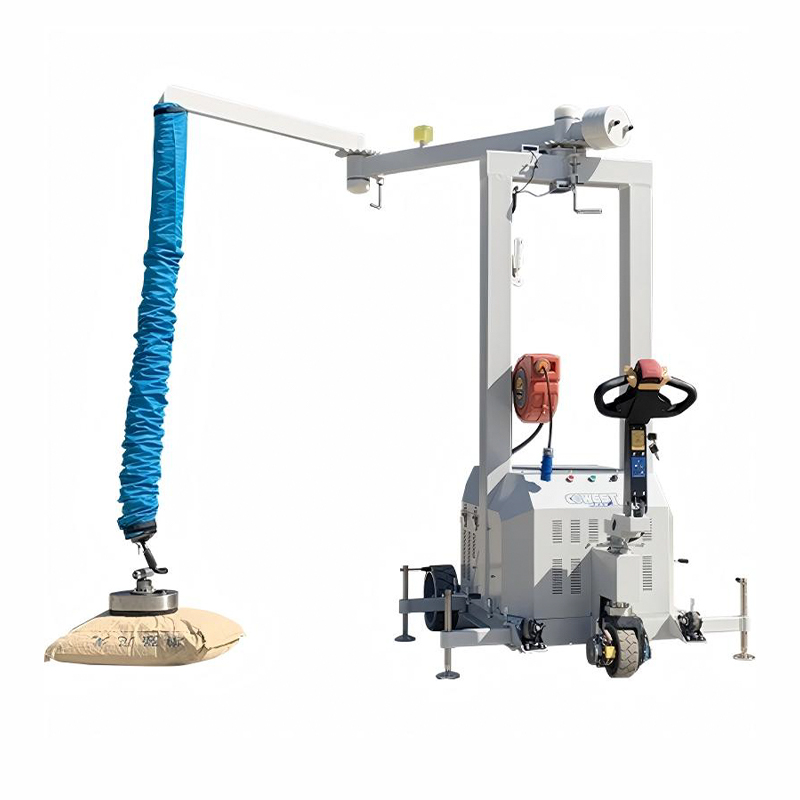
- Mobile cleanroom lifting machines — Self-contained, wheeled vacuum lifters that allow a single operator to handle loads across multiple workstations without fixed overhead infrastructure. A mobile suction cup lifting machine for flexible cleanroom operations is particularly valuable in facilities where the production layout changes regularly or where overhead crane installation is not feasible.
- Fixed vacuum lifting stations — Permanently mounted at a specific process station, typically integrated with a jib arm or overhead rail system. A fixed suction cup lifting machine for integrated workstations delivers consistent positioning accuracy and suits high-throughput lines where the same lift cycle is repeated continuously.
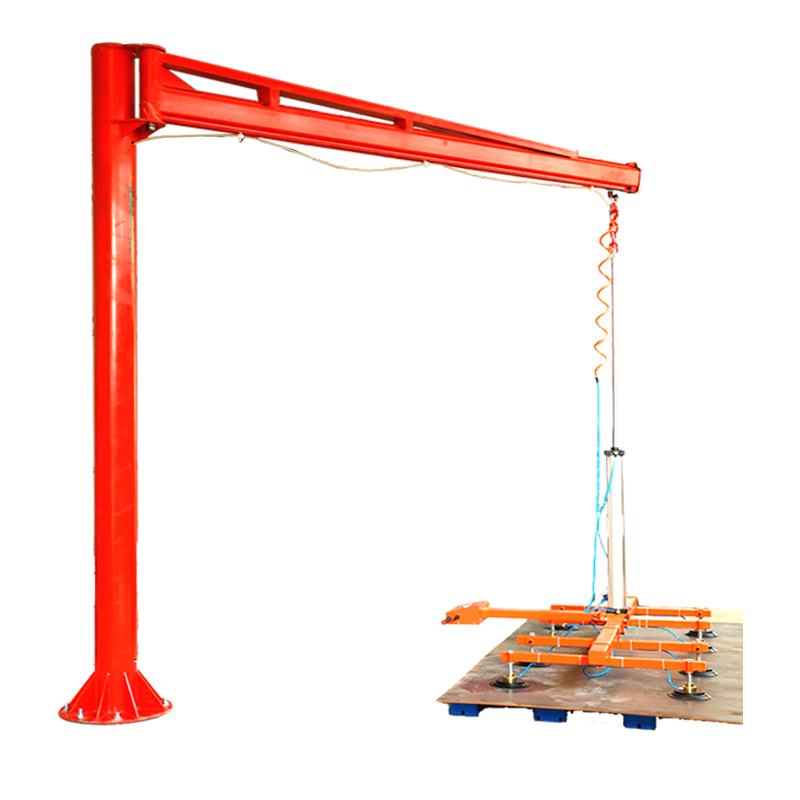
- Jib cranes and overhead rail systems — Provide the overhead infrastructure onto which vacuum lifters, hoists, or tube lifters are mounted. In cleanroom environments, jib crane solutions for overhead lifting infrastructure must be constructed entirely from stainless steel or coated aluminum with sealed bearings and no open cable trays that can accumulate particles.
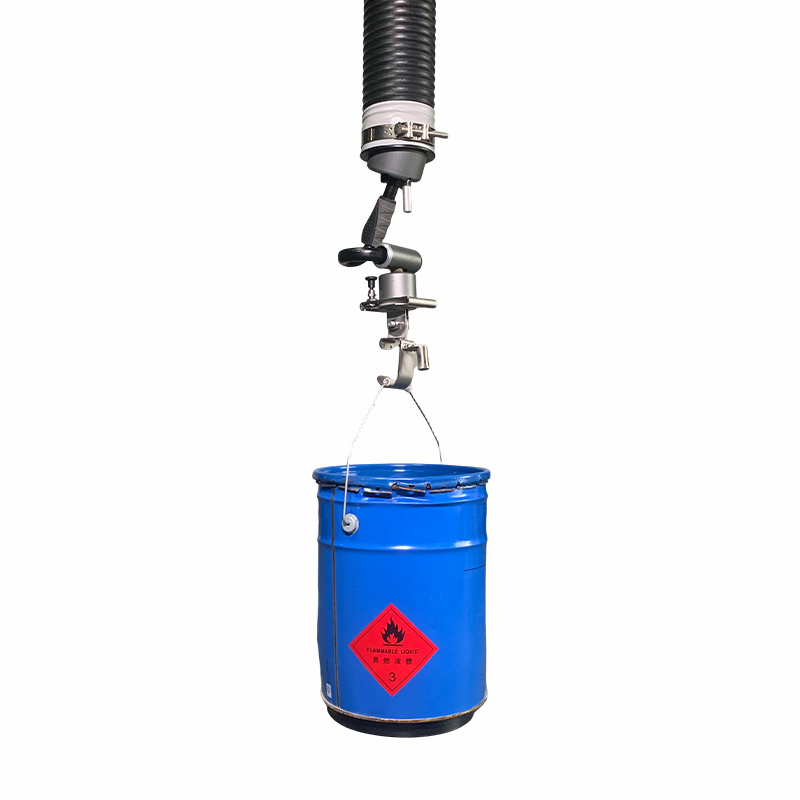
- Pneumatic tube lifters — Lightweight, operator-guided devices suspended from a rail system and powered by compressed air. Well-suited to high-frequency handling of smaller, lighter items such as pharmaceutical containers, vials, or packaged components. In cleanroom configurations, the exhaust air must be directed away from sensitive zones.
Vacuum Lifters in Cleanroom Environments: Specific Design Considerations
Vacuum lifting is the dominant technology for cleanroom material handling of flat or smooth-surfaced loads — but deploying vacuum equipment correctly in a controlled environment requires attention to several design details that standard industrial configurations do not address.
- Compressed air exhaust routing — Venturi-type vacuum generators use compressed air to create vacuum, exhausting that air as a byproduct. In a standard workshop, this exhaust vents directly into the room. In a cleanroom, this is unacceptable — the exhaust carries entrained particles from the air supply and from the generator itself. Cleanroom vacuum systems must route exhaust air through ducting to outside the classified zone, or use electric-driven vacuum pumps that do not generate exhaust within the room at all.
- Suction cup material specification — Standard nitrile rubber suction cups are not appropriate for most cleanroom applications. Silicone cups can be used in many environments but must be verified as low-migration grades for semiconductor and optics applications. Polyurethane and EPDM are options for specific chemical compatibility requirements. All cup materials must be documented in the facility's equipment qualification records. For maintenance guidance relevant to cleanroom deployments, see these suction cup maintenance tips for reliable performance.
- Filtration between load and pump — In cleanroom vacuum systems, particulate filters are placed in the air path between the suction cups and the vacuum generator to prevent any particles lifted from the workpiece surface from entering and contaminating the vacuum system — or being re-released during the next lift cycle.
- Hose and fitting materials — All hoses, connectors, and fittings in the vacuum circuit must be made from cleanroom-compatible materials. Braided hoses with exposed fabric weave shed fibers and are not acceptable; smooth-bore, stainless-reinforced or polyurethane hoses are the correct specification.
- Leak-down rate and safety monitoring — Cleanroom vacuum lifters must include continuous vacuum monitoring with audible and visual alarms, plus check valves that maintain load retention in the event of pump failure. For a full technical breakdown of these safety requirements, see this guide on how vacuum lifting devices work and how to choose one, and for load-specific configuration guidance, the complete buying guide for vacuum panel and sheet lifters covers panel weight, cup count, and frame geometry decisions.
Industries That Depend on Cleanroom Lifting Equipment
Cleanroom lifting requirements are not confined to one sector. Any industry where airborne contamination can compromise product integrity, patient safety, or regulatory compliance needs purpose-built lifting solutions.
- Pharmaceutical and biotech manufacturing — Sterile drug product filling, lyophilization loading, and bioreactor component handling all take place in ISO 5–7 environments where even trace contamination can invalidate an entire production batch. Equipment must support GDP (Good Distribution Practice) documentation and be included in the facility's equipment qualification program.
- Semiconductor and microelectronics fabrication — Wafer handling, photomask transport, and flat panel display glass loading occur in ISO 3–5 environments where sub-micron particle counts are controlled to parts per cubic meter. Lifting equipment must be evaluated for electrostatic discharge (ESD) compatibility in addition to particle generation.
- Medical device assembly — Components for implantable devices, sterile disposables, and diagnostic equipment are assembled in controlled environments where biological contamination is the primary risk. Equipment must be autoclavable or chemical-sterilization compatible in some cases.
- Aerospace and defense manufacturing — Precision optical systems, guidance electronics, and satellite components are assembled in cleanrooms where contamination affects optical performance and long-term reliability. Cleanroom lifters here must often meet additional outgassing specifications for space-rated applications.
- Food and beverage processing — High-care and high-hygiene zones in food production are essentially cleanrooms by another name. Equipment must withstand daily high-pressure washdown, resist corrosion from cleaning chemicals, and meet food safety regulations including HACCP requirements.
Specifying a Cleanroom Lifter: A Practical Checklist
Cleanroom lifting equipment procurement differs from standard industrial equipment purchasing in one critical way: the environment validates the specification, not the other way around. The process must start with the room's requirements and work outward to the equipment, not the reverse.
- Confirm the ISO classification of the operating zone. Obtain the current certification documents for the cleanroom. If the room spans multiple classifications — a common situation in pharmaceutical facilities with ISO 7 and ISO 5 sub-zones — specify the equipment for the most stringent zone it will enter.
- Define the maximum load weight and dimensions. Include the weight of any tooling, fixtures, or product packaging that will be lifted, not just the product itself. Add a safety margin of at least 25% to the calculated maximum for equipment sizing purposes.
- Identify the workpiece surface characteristics. Flat, smooth, non-porous surfaces suit vacuum lifting directly. Porous, perforated, or very rough surfaces require mechanical gripping alternatives. Confirm the surface finish specification of the product to ensure suction cup contact will not mark or scratch it.
- Specify the material grade required for the room. ISO 7 and above typically requires 304 stainless; ISO 5–6 and aggressive chemical environments require 316/316L. Confirm surface finish requirements — Ra 0.8 µm is a common pharmaceutical standard — with the facility validation team.
- Determine power source constraints. Compressed air is available in most industrial cleanrooms and suits pneumatic vacuum generators, but exhaust routing must be designed into the installation. If exhaust routing is impractical, specify an electric vacuum pump. Confirm voltage and connection requirements for electric systems.
- Establish cleaning and disinfection protocols. Identify the cleaning agents used in the room — IPA, quaternary ammonium compounds, hydrogen peroxide vapor, sodium hypochlorite — and verify that all equipment materials and surface treatments are compatible with these agents at the concentrations and frequencies used.
- Confirm documentation requirements. Regulated environments require IQ/OQ/PQ (Installation, Operational, Performance Qualification) documentation for lifting equipment. Confirm with the facility's validation team what documentation the supplier must provide before purchase.
- Plan for maintenance access and spares. Suction cups, seals, and filters are consumable items. Confirm that replacement parts are available in cleanroom-compatible grades, and that maintenance procedures can be performed without introducing contamination into the classified zone.