
 English
 русский
 Español
 عربى
Plate Leveling for Commercial Vehicle & Trailer Body Lines | JingShi
In a high-volume plate line, the leveler rarely sets the pace by speed alone. It sets it by whether flat plate reaches the press or bending line on time. Raising the run speed on its own costs flatness, and slow loading wastes the speed the machine already has. We match leveling speed, roller count, loading method and downstream takt as a whole, so continuous output improves without giving up flatness. For medium-thick body plate we recommend our 60 Series, with automatic loading and conveying sized to your capacity.
Why a Faster Leveler Does Not Always Mean More Output
Commercial vehicle and trailer body plate is mostly medium thickness and runs in large volumes, so the question is rarely whether the plate can be leveled. It is whether it can be leveled fast enough, and flat enough, to keep the stamping and bending lines busy. Three conditions explain most shortfalls:
A plate needs enough bending cycles to deform plastically. Pushing the line faster without changing the roller setup leaves waves in the plate.
Manual or crane loading leaves gaps between plates, so real throughput is lower than the machine speed suggests.
If leveled plate varies from sheet to sheet, the stamping or bending line needs adjustments and stops to make them.
Output per shift is set by the slowest or least stable step, not by the fastest. A leveler that is quick but inconsistent, or one that waits for plate, does not raise the output of the line.
Measure throughput at the end of the line, in sheets per hour that pass flatness inspection, not at the leveler's rated speed.
How We Match Leveling to Your Line Takt
Our approach is to start from the takt the next process needs and work back, rather than start from a machine speed. Four steps make that work in practice.
Start from Your Downstream Takt and Output
We begin with the output you need and the cycle time of your stamping or bending line, together with the plate size, thickness and material. Those define the throughput the leveler has to deliver. Our pre-sales team reviews your drawings or samples before a configuration is proposed.
Balance Speed, Roller Count and Flatness
Speed is not a free variable. If the plate moves too fast, it can float between the rollers without enough plastic deformation. More rollers give more bending cycles in one pass, so the plate reaches the target flatness in a single pass. The 60 Series uses 21 rollers with line speed adjustable from 1 to 10 m/min, so the two can be set together.
Design Loading and Conveying as Part of the Line
A leveler that waits for plate wastes its speed. We design the loading and conveying with the machine, using options such as an automatic loading/unloading manipulator or palletizing robot, powered feed and discharge roller conveyors, and for coil-fed production an uncoiler with a cutting line or laser blanking line.
Check the Whole Cycle Before You Commit
We offer sample testing and trial runs to validate flattening accuracy before purchase. The loading and conveying layout is reviewed against your line at the same time, so throughput is checked for the whole cycle and not only for the leveler.
Which JingShi Leveler Fits High-Volume Plate Lines
For medium-thick body plate in high volume we recommend the 60 Series, with its key figures below.
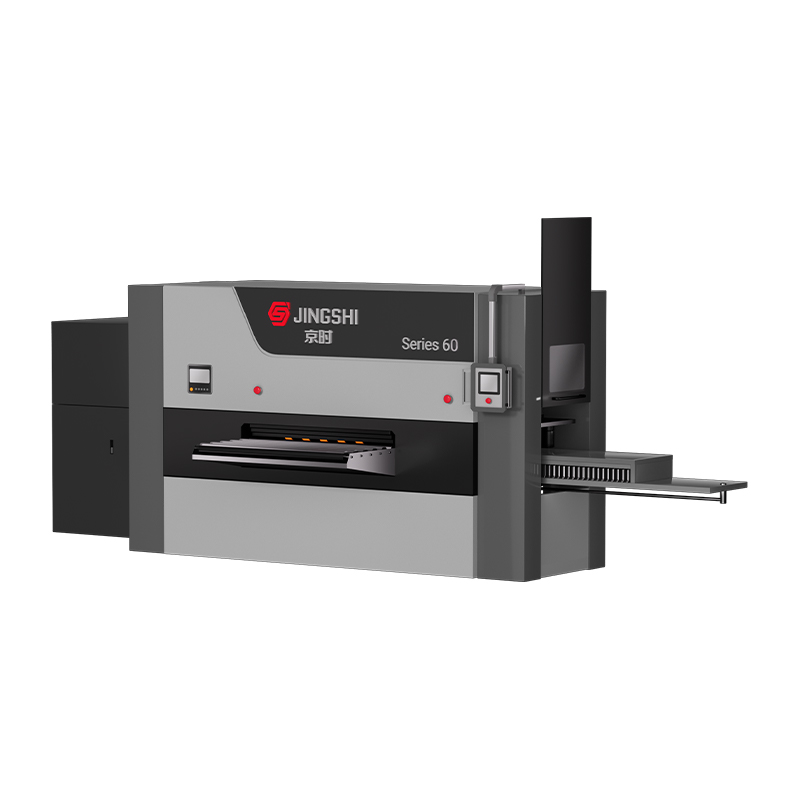 Recommended model 60 Series Thick Plate High-Efficiency Hydraulic Leveling Machine 21-roller hydraulic leveling for plate from 1.0 to 8.0 mm, with adjustable line speed, saved recipes and options for automatic loading, conveying and cutting lines. View product details →
Leveling accuracy is 0.01 to 0.05 mm, measured on Q235 reference material (235 MPa yield strength) within 1 m. The throughput you actually reach depends on your plate, your target flatness and how the machine is fed, so we confirm the cycle on your own samples.
| Requirement | Recommended configuration | Why it fits |
|---|---|---|
| Medium-thick plate in high volume | 60 Series with 21 rollers, 60 mm each | More bending cycles per pass, so the plate reaches the target flatness in one pass |
| Matching the press or bending line takt | Adjustable speed from 1 to 10 m/min with saved recipes | Sets the speed for each plate type and recalls it for the next run |
| Continuous loading and stacking | Optional loading/unloading manipulator or palletizing robot, with powered feed and discharge conveyors | Keeps the leveler fed and the output moving without idle gaps |
| Coil-fed volume production | Optional uncoiler with cutting line or laser blanking line | Runs continuously from coil to leveled, cut sheets |
| Plate thicker than 8 mm | 80 Series (nominal 2.0 to 10.0 mm, max 25 mm) | More load capacity for thicker body and chassis plate |
For coil-fed volume production, our High Precision Decoiler Straightener Feeder & CTL Line combines uncoiling, straightening, servo feeding and shearing, with a cut length accuracy of ±0.5 mm at speeds up to 80 m/min. For thicker plate, see our 80 Series Heavy-Duty Plate Hydraulic Ultra-Precision Leveling Machine.
- Plate material, thickness range, width and length, or coil size
- Required output per shift
- Cycle time of the stamping or bending line that follows
- Target flatness and how it is measured
- The problem you see: waves, flatness variation between sheets, or the leveler waiting for plate
- Current loading, conveying and stacking method
- Available floor space and existing handling equipment
As a professional Plate Leveling for Commercial Vehicle & Trailer Body Lines Manufacturer and a reliable Leveling Machine Supplier in China, we offer customized solutions tailored to your materials and production needs. Our equipment is widely used in automotive parts, precision sheet metal, elevator components, agricultural machinery, saw blades, precision stamping, profile manufacturing, and electrical applications. Through continuous innovation and technical excellence, JingShi has become a trusted partner for manufacturers around the world.



