
 English
 русский
 Español
 عربى
Sheet Metal Leveling for Solar Brackets & Module Frames | JingShi
Soft aluminum and thin-wall galvanized sheet can leave a leveler in worse shape than it entered. These materials yield at low load, so a leveling pressure that is slightly too high does not remove the original deformation. It creates a new, local plastic deformation instead. We avoid this by reducing the deformation of each bend, adjusting the roll gap in fine steps, and leveling progressively, with aluminum and thin-wall parts validated on samples first. For this work we recommend our 30 Series precision thin plate leveler.
Why Over-Leveling Creates New Deformation in Soft Stock
Solar mounting brackets and module frames are made from thin material that is soft by design: aluminum sheet and strip, and thin-wall galvanized sheet. The same softness that makes these materials easy to form makes them easy to damage in a leveler. Three conditions explain most over-leveling:
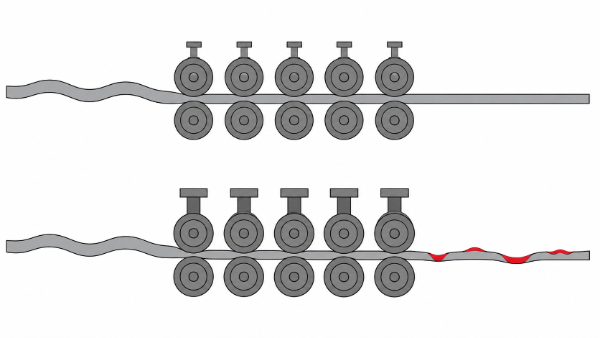
Soft material yields at low load, so the window between correcting the old deformation and creating a new one is narrow.
Too much deformation in a single bend goes beyond what the sheet needs and leaves local plastic deformation behind.
A thin section reacts strongly to small variations in pressure, so minor roll gap drift shows up as visible distortion.
The starting deformation also changes from coil to coil, so a setting that works on one lot can over-level the next. For brackets and frames that must assemble square and sit flat on a module, a part that comes out worse than it went in has defeated the purpose of leveling.
Over-leveling is hard to see on the machine. Judge a setting by flatness after leveling and by part dimensions, not by how hard the sheet was pressed.
How Progressive Leveling Avoids New Plastic Deformation
Our approach is to correct the sheet in many small, controlled steps instead of one forceful pass. Four steps make that work in practice.
Read Yield Strength and Starting Deformation
Yield strength tells us how much bending the material can take before it deforms permanently, and the starting deformation tells us how much correction is needed. Together they set the safe amount of deformation per bend. Our pre-sales team reviews your drawings or samples before a setting is proposed.
Reduce the Deformation of Each Bend
We lower the deformation applied at each roller and let the number of bends do the work. A dense layout of small rollers bends the sheet repeatedly with moderate penetration, which relieves the original deformation without a heavy hit at any single point.
Adjust the Roll Gap in Fine Steps
On the 30 Series, hydraulic servo control gives real-time pressure feedback, and the roll gap is set digitally from the touch screen. We approach the final gap in small increments, so the sheet is leveled progressively instead of being forced flat. Once a setting is verified for a material and thickness, it can be saved as a recipe.
Validate Aluminum and Thin Parts on Samples First
For aluminum and thin-wall parts, we recommend validating the parameters on your own samples before production. We offer sample testing and trial runs to confirm flattening accuracy before purchase. For aluminum we also check the surface for marks, and roller material and surface treatment can be discussed to suit it.
Which JingShi Leveler Fits Soft Thin Stock
For thin aluminum and galvanized sheet we recommend the 30 Series, with its key figures below.
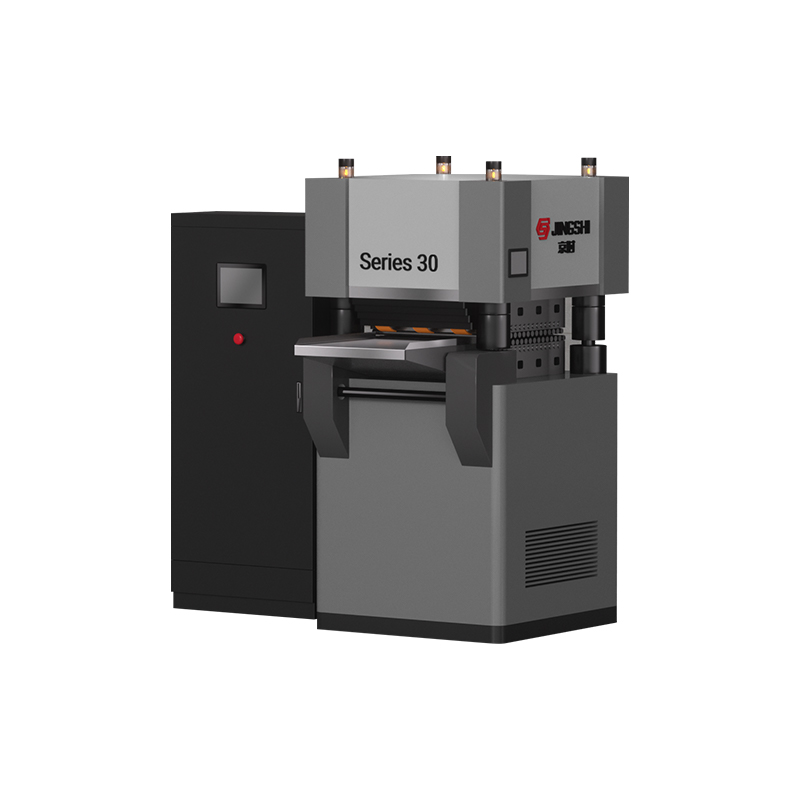 Recommended model 30 Series Thin Plate Hydraulic Servo Precision Leveling Machine Hydraulic servo leveling for thin sheet from 0.5 to 3.0 mm, with fine digital roll gap control, saved recipes and optional roller pull-out for cleaning. View product details →
The accuracy figure is measured on Q235 reference material (235 MPa yield strength). Aluminum and galvanized sheet behave differently, which is why we validate parameters on your samples before recommending a setting.
| Requirement | Recommended configuration | Why it fits |
|---|---|---|
| Soft, low-yield material | 23 small-diameter rollers, 30 mm each | Bends the sheet many times with small deformation per bend |
| Precise control of pressing force | Hydraulic servo control with real-time pressure feedback and a digital roll gap | Lets the gap be approached in fine steps instead of overshooting |
| Switching between aluminum and galvanized sheet | Touch-screen parameter input with saved recipes | Recalls a verified setting for each material and thickness |
| Surface-sensitive aluminum | Optional roller pull-out (downward, sideways, or up and down) | Speeds up roller cleaning and quick change to keep the surface clean |
| High-volume coil-fed bracket production | Uncoiler with cutting line or laser blanking line, with powered feed and discharge conveyors | Combines leveling and cut-to-length in one continuous line |
For thicker bracket plate, our 60 Series Thick Plate High-Efficiency Hydraulic Leveling Machine covers 1.0 to 8.0 mm, up to 15 mm. For stock thinner than 0.5 mm, we evaluate a sample before recommending a machine. For coil-fed production, see our coil leveling line range.
- Material and alloy or coating grade, with yield strength if known
- Thickness range, width and length, or coil size
- The deformation you see and how it changes between lots
- Whether surface marks are acceptable
- Target flatness and how it is measured
- Required output
- The process that follows, such as roll forming, punching or bending
As a professional Sheet Metal Leveling for Solar Brackets & Module Frames Manufacturer and a reliable Leveling Machine Supplier in China, we offer customized solutions tailored to your materials and production needs. Our equipment is widely used in automotive parts, precision sheet metal, elevator components, agricultural machinery, saw blades, precision stamping, profile manufacturing, and electrical applications. Through continuous innovation and technical excellence, JingShi has become a trusted partner for manufacturers around the world.



