
 English
 русский
 Español
 عربى
Sheet Metal Leveling for Metal Furniture Components | JingShi
A small stamped furniture part can come out of a complex die with a warped corner even though the blank was flat. The flatness was only on the surface: internal residual stress was still in the plate, and stamping redistributed it. We determine the effective leveling zone from the part size and the forming process, and we work on the internal stress state of the material rather than on surface flatness alone. For irregular, small blanks we recommend our 30 Series precision thin plate leveler, with a custom feed and discharge structure where the parts are small.
Why Flat Blanks Still Warp After Stamping
Metal furniture components are often small and irregular, and many are stamped into complex shapes. The stamping die asks the material to flow, and any stress left in it flows too. Three conditions explain why a flat blank still warps:
Leveling that only presses the surface flat leaves stress in the plate, and stamping takes material away and redistributes it.
The ends of a short piece pass the rollers with less support, so the zone that is fully leveled can be smaller than the part.
Small blanks with irregular shapes can skew or tilt on the way through, so the result varies from piece to piece.
The warp appears after the die, when it is expensive to deal with. Parts miss their dimensions, die settings are adjusted to compensate, and good blanks are rejected for local distortion.
Judge leveling by the shape of the part after stamping, not by the flatness of the blank, and run a few blanks through your real die during the trial.
How We Define the Effective Leveling Zone
Our approach is to work out which part of the blank matters for the forming step, then level that zone for stress and not only for flatness. Four steps make that work in practice.
Start from Part Size and Forming Process
We begin with the part dimensions and outline, the thickness and material, and how complex the stamping is. These show which area of the blank becomes the formed feature. Our pre-sales team reviews your drawings or samples, and we offer sample testing and trial runs to validate the process before purchase.
Define the Effective Leveling Zone for Each Part
From the part size and the forming process, we decide where the stress state must improve and check that against what the machine can handle. On the 30 Series, the shortest workpiece length for leveling is 60 mm. We focus on improving the internal stress state of the material, not only on making the surface flat.
Work the Stress Out with Many Small Bends
The 30 Series bends the blank through 23 small rollers, so stress is released gradually through repeated, moderate bends instead of one heavy pass. Hydraulic servo control gives real-time pressure feedback, and settings for each material can be saved as recipes, for example one for 304 stainless steel and another for 5052 aluminum.
Match Feed and Discharge to the Part
Small, irregular blanks need guiding on the way in and out. We offer feeding and discharging roller lines, with or without power, an automatic loading/unloading manipulator or palletizing robot, and custom requirements are accepted, so the feed and discharge structure can be designed around your part.
Which JingShi Leveler Fits Small Stamping Blanks
For small and irregular furniture blanks we recommend the 30 Series, with its key figures below.
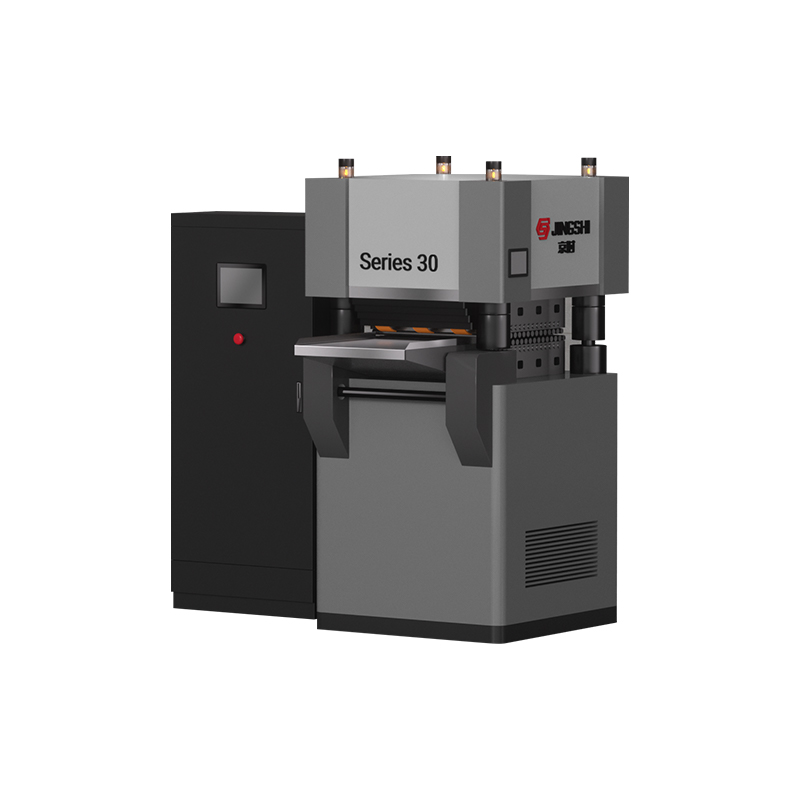 Recommended model 30 Series Thin Plate Hydraulic Servo Precision Leveling Machine Hydraulic servo leveling for thin sheet from 0.5 to 3.0 mm, with workpieces as short as 60 mm, saved recipes and options for custom feeding and discharge. View product details →
Leveling accuracy is 0.01 to 0.05 mm, measured on Q235 reference material (235 MPa yield strength) within 1 m. Parts shorter than 60 mm, or with unusual outlines, need a feed and discharge structure designed for them, and we assess that on your own samples before you decide.
| Requirement | Recommended configuration | Why it fits |
|---|---|---|
| Internal stress before complex stamping | 23 rollers, 30 mm each, with alternating bends | Many small bends release stress instead of only pressing the blank flat |
| Small blanks | Shortest workpiece length of 60 mm, with a custom feed and discharge structure | Guides small and irregular blanks through the rollers |
| Several materials in one shop | Touch-screen roll gap control with saved recipes | Recalls a verified setting for each material and thickness |
| Visible furniture surface | Precision-ground rollers (HRC 58-62), with optional roller pull-out | Keeps the roller surface accurate and quick to clean |
| Many small parts per shift | Feeding and discharging roller line, with or without power, and optional manipulator or palletizing robot | Keeps small parts moving without manual stacking |
| Thicker furniture components | 40 Series (nominal 0.6 to 4.0 mm, max 8 mm) | More load capacity for thicker frame and structural parts |
For thicker components, see our 40 Series Heavy-Duty Hydraulic Precision Leveling Machine. Other width and thickness combinations are covered by our wider hydraulic leveling machine range.
- Part drawings, including the outline and the smallest dimension
- Material and thickness range
- How complex the stamping is, and where warping appears after it
- Blank size and how the blanks are cut: laser, punching or shearing
- Target flatness and how it is checked
- Whether the surface is visible on the finished furniture
- Required output and current feeding method
As a professional Sheet Metal Leveling for Metal Furniture Components Manufacturer and a reliable Leveling Machine Supplier in China, we offer customized solutions tailored to your materials and production needs. Our equipment is widely used in automotive parts, precision sheet metal, elevator components, agricultural machinery, saw blades, precision stamping, profile manufacturing, and electrical applications. Through continuous innovation and technical excellence, JingShi has become a trusted partner for manufacturers around the world.



