 English
 русский
 Español
 عربى
عربى
JingShi
JingShi
JingShi
JingShi
JingShi
JingShi
JingShi
JingShi
JingShi
Content
- 1 What Makes a Plate Leveler "Precision"?
- 2 Common Plate Deformations That Drive the Need for Precision Leveling
- 3 Key Technical Specifications to Evaluate
- 4 Hydraulic vs. Servo-Driven Precision Levelers
- 5 Material and Thickness Compatibility
- 6 Industry Applications Where Precision Matters Most
- 7 How to Choose the Right Precision Plate Leveler
What Makes a Plate Leveler "Precision"?
A standard roller leveler straightens metal by passing it through a set of offset rollers — effective for general flatness, but not built for tight tolerances. A precision plate leveler goes several steps further. It applies controlled, alternating bending forces across the full width and length of the plate, progressively reducing residual stress until the material exits in a genuinely flat condition — not just visually flat, but dimensionally stable.
The distinction matters because downstream processes are unforgiving. Laser cutting, CNC milling, and precision stamping all depend on a plate that stays flat after it leaves the leveler. A machine that only approximates flatness during processing — but releases stored stress when the material is cut or welded — creates compounding problems on the production floor. For a broader look at how leveling machines are classified and what they do, see this complete guide to leveling machines and how they work.
Industry flatness standards — most commonly ASTM A6 for carbon steel and ASTM A480 for stainless — define how much deviation from a flat plane is permissible over a given length. Precision levelers are engineered to consistently meet or exceed these tolerances, often achieving results tighter than what mill-produced plate can guarantee. For background on what these tolerances mean in practice, this breakdown of steel flatness standards and leveling methods offers a useful reference point.
Common Plate Deformations That Drive the Need for Precision Leveling
Metal plate rarely arrives perfectly flat. The deformation introduced during rolling, heat treatment, laser cutting, or even transportation is a structural reality — and each type requires a different leveling response.
- Edge wave — The edges of the plate are longer than the center, creating a wavy perimeter. Common in wide coil-processed material where edge tension was unevenly distributed.
- Center buckle — The opposite condition: the center is longer than the edges, causing the plate to dome or bubble. Frequently seen after hot rolling or flame cutting.
- Longitudinal bow — The plate curves along its length, like a gentle arc from end to end. Residual stress from quenching or uneven cooling is the usual cause.
- Crossbow — Curvature running across the width of the plate rather than its length. Often linked to asymmetric rolling or annealing.
- Twist — A torsional deformation where diagonal corners of the plate lift off a flat reference surface. One of the most difficult forms of distortion to correct.
Laser and plasma cutting introduce their own deformation — localized heat warps the area surrounding the cut path, releasing stresses that were locked in during rolling. This is why precision leveling is often required both before and after cutting operations. For a structured overview of the methods used to address each type of deformation, see this full breakdown of sheet metal leveling methods. You can also explore the broader topic of sheet metal flatness tolerance standards to understand where the benchmarks come from.
Key Technical Specifications to Evaluate
Comparing precision plate levelers on price alone is a shortcut to the wrong machine. The specifications below determine whether a given leveler can actually deliver the flatness your process demands.
- Roller diameter — Smaller rollers apply tighter bending radii, which is essential for thin or high-strength materials. Larger rollers are better suited to thick plate where smaller rollers would deflect under load. A mismatch between roller diameter and plate thickness is one of the most common causes of poor leveling results.
- Number of working rollers — More rollers mean more alternating bending cycles per pass, which allows for finer stress relief without over-bending. High-precision applications typically use machines with 17 to 23 rollers or more.
- Roller gap control accuracy — The gap between upper and lower rollers must be adjustable to fractions of a millimeter and held constant across the full working width. Machines with CNC closed-loop control and real-time position feedback from displacement sensors maintain this precision reliably; manually adjusted machines cannot.
- Backup roller configuration — Precision levelers use densely arranged backup rollers behind the working rollers to prevent deflection under load. Without adequate backup support, the rollers themselves will bow, and flatness across wide plates will be inconsistent.
- Roller material and hardness — Working rollers made from high-strength alloy steel, hardened to HRc 58–63 and surface-ground, maintain their geometry over long production runs. Softer rollers wear unevenly and introduce flatness variation over time.
- Working width and maximum plate thickness — These define the machine's process range and should be matched to both current and anticipated future requirements, including safety margin.
Hydraulic vs. Servo-Driven Precision Levelers
Two drive architectures dominate the precision leveling market. Understanding how they differ helps clarify which is right for a given production environment.
| Feature | Hydraulic Precision Leveler | Servo-Driven Precision Leveler |
|---|---|---|
| Gap Control Method | Hydraulic cylinder with position sensor feedback | Servo motor + turbine gearbox, CNC closed-loop |
| Positioning Accuracy | High — typically ±0.01 mm range | Very high — real-time correction, constant during operation |
| Best For | Thick plate, heavy-duty structural applications | Thin to medium plate, high-mix production, tight flatness specs |
| Maintenance Profile | Hydraulic seals and fluid management required | Lower fluid maintenance; servo drives require calibration |
| Automation Compatibility | Good — integrates with PLC-controlled lines | Excellent — native CNC integration, data logging capable |
Hydraulic systems excel where raw leveling force is the primary requirement — thick structural plate in heavy fabrication or shipbuilding environments. Servo-driven systems are preferred where the production mix changes frequently, flatness tolerances are tighter, or where data traceability for quality systems is needed. For a closer look at how intelligent hydraulic leveling technology is evolving, see this article on dual-core technology breakthroughs in intelligent hydraulic leveling. The full hydraulic precision leveling machine product line covers a range of configurations suited to different plate thicknesses and output requirements.
Material and Thickness Compatibility
Not all precision plate levelers handle every material equally. The elastic recovery behavior of a material — how much it springs back after bending — directly affects how the machine must be set up, and whether a given roller configuration can achieve target flatness.
- Carbon steel — Relatively predictable springback behavior. Standard precision levelers handle the full thickness range from thin sheet to heavy plate, with machine selection driven primarily by maximum thickness and working width.
- High-strength steel (HSLA, AR plate) — Higher yield strength means significantly more springback. Thicker-roller, higher-force machines are required. Attempting to level high-strength plate on a machine sized for mild steel will result in incomplete correction and potential roller damage.
- Stainless steel — Work-hardens during leveling, which alters springback as the pass progresses. Austenitic grades (304, 316) are manageable; duplex and martensitic grades require machines with higher force capacity and finer gap control.
- Aluminum — Softer and more scratch-sensitive than steel. Precision levelers for aluminum typically use polished roller surfaces and may include dedicated roller configurations to avoid surface marking. Wide-format aluminum plate is common in aerospace and marine applications.
- Copper and brass — Ductile but prone to surface damage from aggressive bending. Lower leveling forces and carefully controlled roller gaps are required.
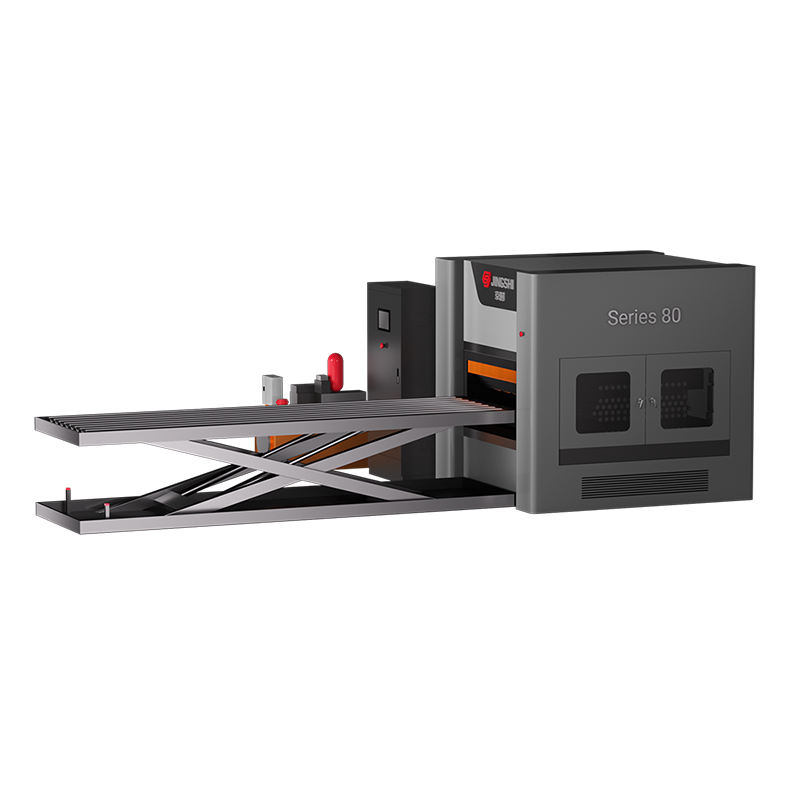
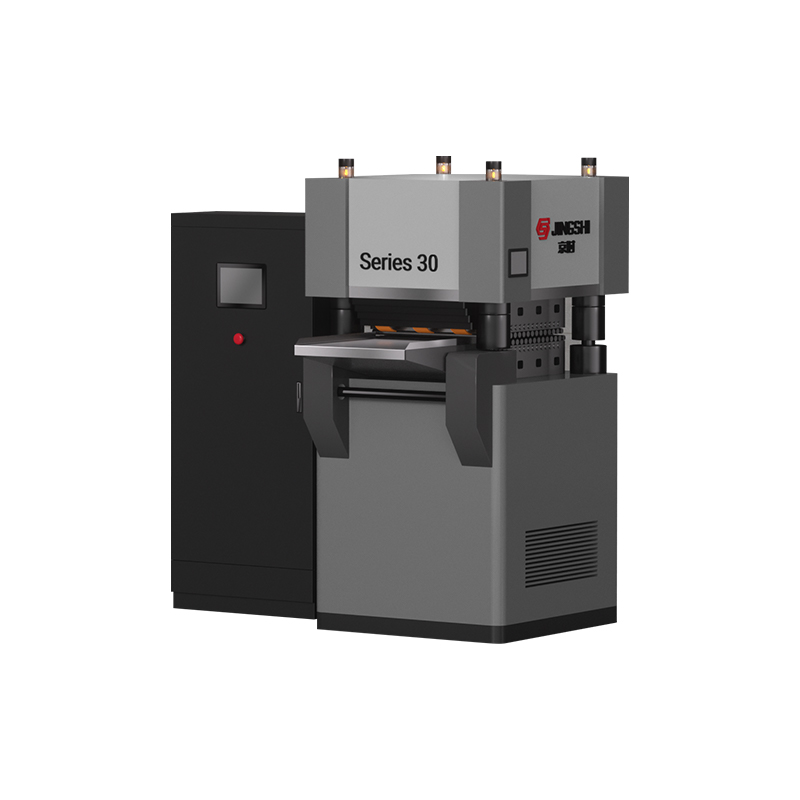
For thin plate applications down to 0.3 mm, a machine like the 30-series thin plate servo precision leveling machine provides the fine gap control and roller configuration needed. For heavy plate up to 80 mm and above, the 80-series heavy-duty ultra-precision leveling solution is designed for the force requirements and thermal stability those thicknesses demand.
Industry Applications Where Precision Matters Most
Precision leveling is not universally required — but in certain industries, out-of-flat plate is not a cosmetic problem. It is a process failure.
- Laser and plasma cutting — Plate that is not flat at the cutting head causes inconsistent focus distance, leading to edge burn, incomplete cuts, and dimensional inaccuracies in finished parts. Most laser cutting equipment specifies a flatness tolerance for incoming material that standard mill plate cannot consistently meet.
- Automotive stamping — Progressive die tooling operates at extremely tight clearances. Incoming blanks that deviate from flat cause die wear, part rejection, and downtime for tool adjustment.
- Aerospace components — Aluminum and titanium plate used in structural airframe components must meet flatness specifications that are tighter than general commercial tolerances by an order of magnitude.
- Precision mold and toolmaking — Mold bases and die plates are machined to tight tolerances on all faces. A warped starting plate wastes machining time and creates thermal stress during heat treatment.
- Electronic enclosures and precision sheet metal fabrication — Panels that must flush-fit after assembly have no tolerance margin for bowing or edge lift.
- Shipbuilding and heavy structural fabrication — Large structural plates must meet flatness requirements for accurate fit-up during assembly welding. Even small deviations in large-format plates create cumulative alignment problems across a hull section or structural frame.
How to Choose the Right Precision Plate Leveler
A structured selection process avoids the two most common mistakes: over-specifying a machine that exceeds what the application actually requires, or under-specifying one that can't consistently hit target flatness under production conditions.
- Define your plate thickness range. This single parameter eliminates most options immediately. Specify both the minimum and maximum thickness you need to process, including materials you expect to run in the next three to five years, not just today's production mix.
- Identify your materials. List every material type and grade you will level. High-strength or work-hardening alloys require machines with higher force capacity and more sophisticated gap control than mild steel of the same thickness.
- Set your flatness target. Translate your downstream process requirements — laser cutting, milling, stamping — into a specific flatness specification. This becomes the performance benchmark the machine must meet, not an aspiration.
- Determine working width. Match the maximum plate width you process to the machine's working width, with sufficient margin so edge-to-edge leveling performance is not compromised.
- Choose the drive architecture. If your production is dominated by thick structural plate at consistent thicknesses, hydraulic systems offer excellent force and reliability. If you run a high-mix operation with frequent changeovers across different thicknesses and materials, servo-driven CNC systems reduce setup time and improve repeatability.
- Evaluate integration requirements. Does the leveler need to feed directly into an automated cutting or blanking line? Data logging and remote diagnostics requirements? These define the control system specification.
- Request a leveling trial. For high-value applications, reputable manufacturers will run sample plate through the proposed machine and provide documented flatness measurements before purchase commitment.
For further guidance on how to approach a machine consultation and what technical information to prepare, see this resource on what to prepare when consulting on leveling machinery.